
Ayurvedic Diet Plan for Patients: How to Make and Share
25 November 2026 · AyurHealthPlus
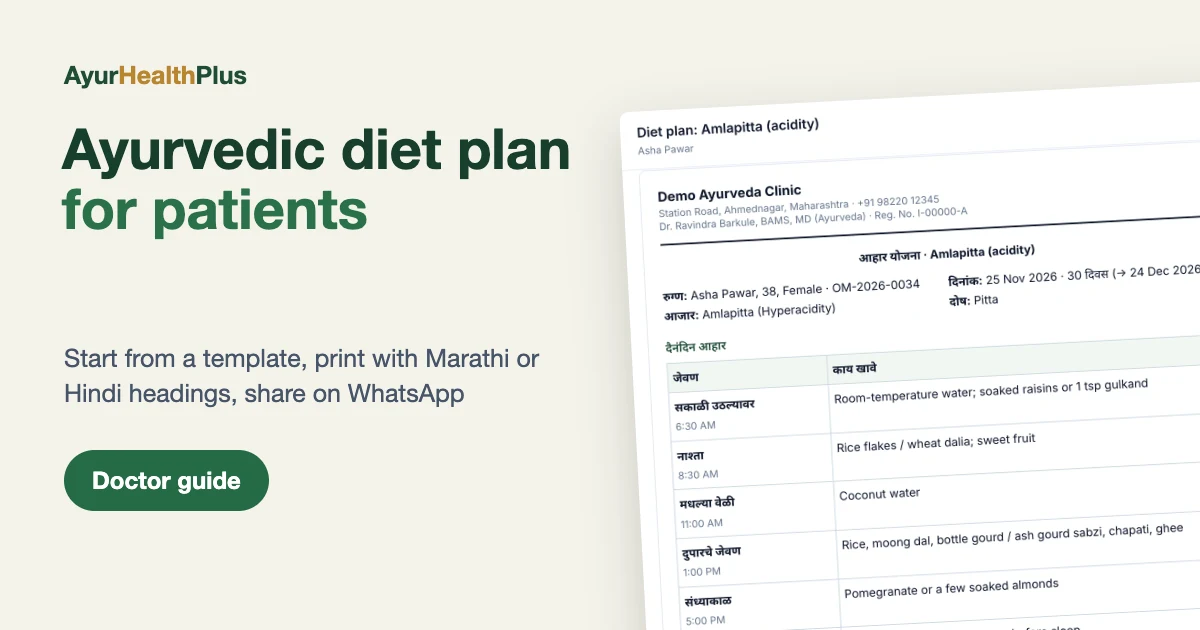
How to make a clear Ayurvedic diet plan for each patient: meal times, Pathya and Apathya, Vihara and a review date, shared as a PDF or on WhatsApp.
Short answer: A good Ayurvedic diet plan for a patient has five parts: the meal timetable (what to eat on waking, at breakfast, lunch, evening and dinner), Pathya and Apathya by food group (what to take and what to avoid), Vihara (sleep, exercise, routine), special instructions such as Viruddha Ahara, and a review date. Start from a template for the condition or Dosha, change it for this patient, and give it in writing: printed, as a PDF, or on WhatsApp.
This guide is for BAMS and MD (Ayurveda) doctors who advise diet in the OPD or during Panchakarma.
Key points
- Good diet advice is more than "avoid spicy food". Write meal times and actual foods.
- Use templates as a starting point, never as the final plan.
- Write Pathya and Apathya by food group, so the patient can follow it in their own kitchen.
- Add Vihara: sleep, exercise and daily routine matter as much as food.
- Give a review date, and update the plan at the follow-up.
Why give patients a written Ayurvedic diet plan?
Most patients forget spoken diet advice by the time they reach home. Written advice is something the family can stick on the kitchen wall. It also helps the doctor at the follow-up: you can see exactly what was advised, and what to change.
What an Ayurvedic diet plan should include
- Patient details: name, age, OPD number, diagnosis and Dosha focus
- Duration: start date and number of days (7, 15, 30 or 45)
- Daily meal plan: on waking, breakfast, mid-morning, lunch, evening, dinner, bedtime, with times and quantities
- Pathya and Apathya: grains, pulses, vegetables, fruits, milk and dairy, oils and ghee, spices, drinks
- Vihara: sleep time, walking or yoga, daytime sleep, routine
- Special instructions: water, fasting, Viruddha Ahara (food combinations to avoid)
- Review date and the doctor's name and registration number
For a one-page Pathya–Apathya chart to print and fill by hand, see our Pathya Apathya diet chart.
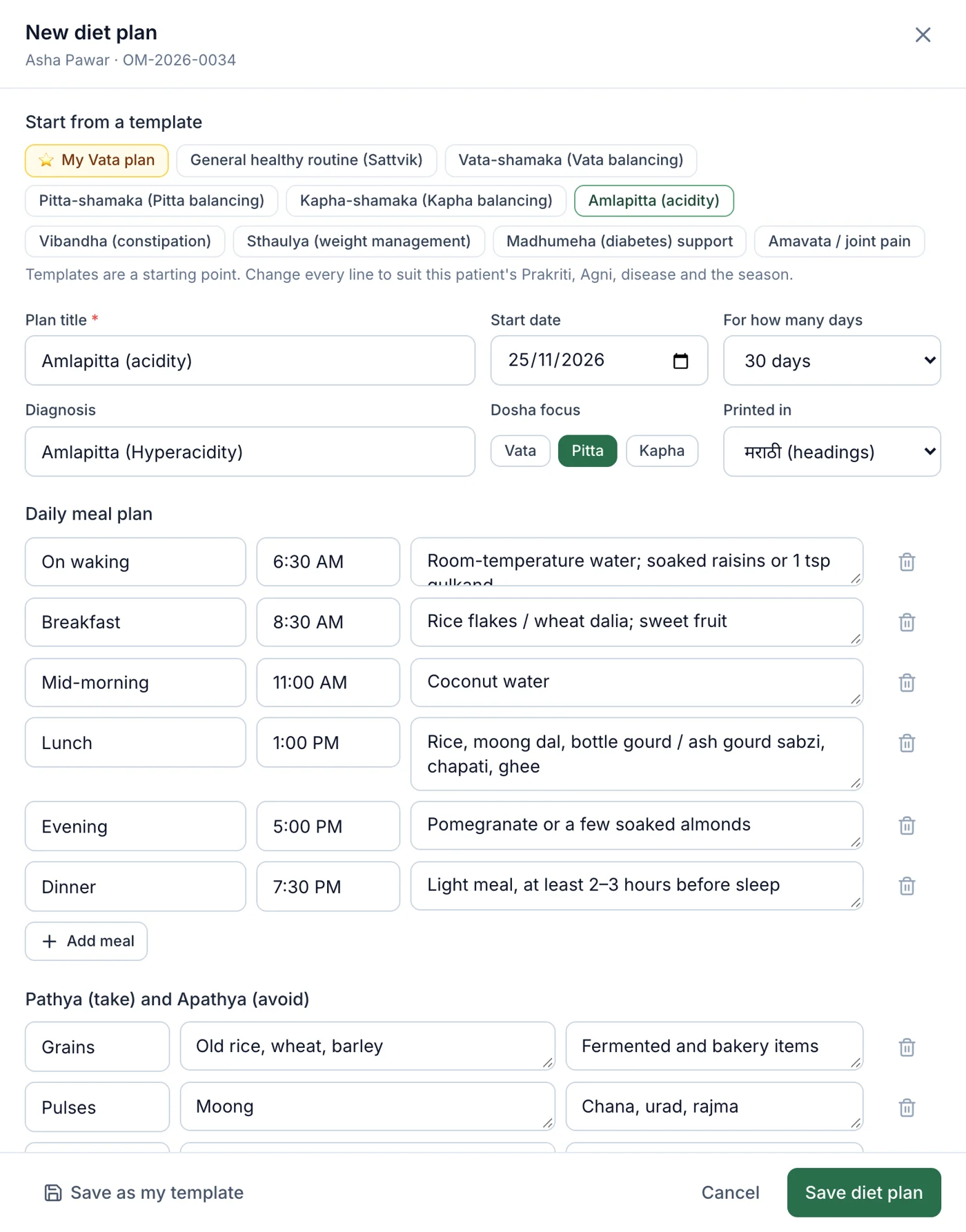
Start from a template, then change it
Most clinics see the same conditions again and again, so templates save time: Vata, Pitta or Kapha balancing, Amlapitta (acidity), Vibandha (constipation), Sthaulya (weight management), Madhumeha support and Amavata or joint pain. But two patients with acidity rarely need the same plan. Change the plan for the patient's Prakriti, Agni, age, work hours, the season and what they actually eat at home.
If you use the same changes often, save them as your own template.
Writing it in the patient's language
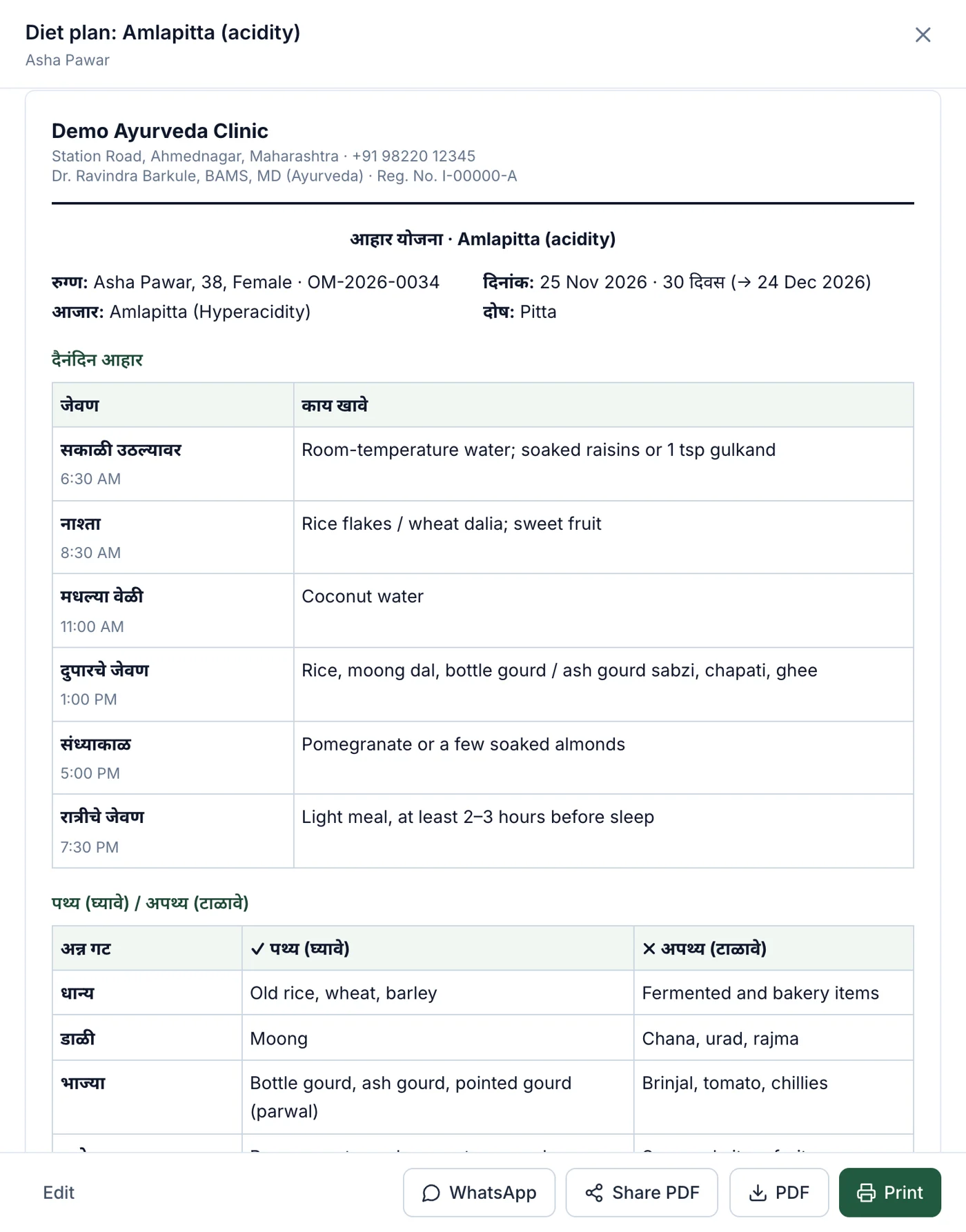
A plan the patient cannot read will not be followed. Print the headings in Marathi or Hindi when that is what the patient reads, and write foods by the names used at home: jowar, moong, dudhi, kokum. Keep sentences short.
Sharing the diet plan
- Printed, on the clinic letterhead, handed over at the end of the visit
- PDF on WhatsApp, which most patients prefer to recieve because it stays on their phone
- WhatsApp message with the plan as text, which is easy to read on any phone
Keep a copy in the patient's record. At the follow-up, open it, ask what was hard to follow, and make the next version.
Common mistakes
- Only a list of foods to avoid. Patients also need to know what to eat instead.
- No meal times. Late dinners undo much of the benefit for acidity and weight.
- The same plan for every patient with the same diagnosis.
- No review date, so the plan is never updated.
- Changing medicines through the diet chart. Medicines belong on the prescription; for diabetes or blood pressure, the plan should say not to stop any medicine.
Diet plans in AyurHealthPlus
Open patient's file (or the consultation you just saved) and choose Diet plan:
- 9 built-in Ayurvedic templates, and your own saved templates
- Diagnosis, Dosha and the Pathya–Apathya from the prescription filled in for you
- Meal timetable, Pathya and Apathya by food group, Vihara, special instructions and review date
- Headings printed in English, Marathi or Hindi
- Saved to the patient's documents; a new version keeps the old one
- Share by WhatsApp, PDF, a phone's share menu, or print on your letterhead
Only doctors can make or change a diet plan. See Ayurvedic history taking software for the case sheet it builds on, and Ayurvedic clinic management software for the full system.
Frequently asked questions
What should an Ayurvedic diet plan include?
A meal timetable, Pathya and Apathya by food group, Vihara (sleep, exercise and routine), special instructions such as Viruddha Ahara, the duration and a review date.
Is a diet chart the same as Pathya–Apathya?
Pathya–Apathya is the list of what to take and what to avoid. A full diet plan also gives meal times, quantities, lifestyle advice and a review date.
Can I use one diet plan for all patients with the same disease?
Use it as a starting point only. Change it for the patient's Prakriti, Agni, age, routine, the season and their usual food.
How should a diet plan be shared with the patient?
Print it on the clinic letterhead, or send it as a PDF or a WhatsApp message, in the language the patient reads, and keep a copy in the record.
Can clinic software make diet plans?
Yes. AyurHealthPlus makes diet plans from templates, fills in the diagnosis and Dosha, prints Marathi or Hindi headings and shares the plan on WhatsApp or as a PDF.