
Panchakarma Consent Form: Format and Free Template
19 November 2026 · AyurHealthPlus
What a Panchakarma consent form should contain, sample wording in plain language, and a free printable template for Ayurvedic clinics.
Short answer: A Panchakarma consent form records that the patient agreed to the procedure after it was explained in a language they understand. It should name the procedure (Vamana, Virechana, Basti, Nasya or Raktamokshana) and the Purvakarma, and list the expected benefit, possible discomforts and diet rules. It also says the patient may withdraw at any time, and carries the signature or name of the patient or guardian, the doctor and a witness. Take it before Purvakarma starts, and keep it with the case paper.
This guide gives Ayurvedic doctors and Panchakarma centres a clear format, sample wording and a free printable Panchakarma consent form (PDF).
Key points
- Take consent before Snehapana or the first Purvakarma session, not on the day of the main procedure.
- Explain the procedure in the patient's language and note which language you used.
- Write the real discomforts plainly: nausea, vomiting, loose motions, fatigue.
- A guardian signs for a minor or for a patient who cannot consent; record the relation.
- When you change the wording of your form, keep the old version with the consents signed on it.
Why take consent for Panchakarma?
Panchakarma procedures cause expected effects that can frighten a patient who was not told about them. Vamana causes vomiting and Virechana causes repeated loose motions, and a Basti course runs for days. Written consent shows that the patient knew what would happen and agreed to it. It also protects the clinic if a patient complains later. The conversation matters more than the paper: the form only records that the explanation happened.
What should a Panchakarma consent form include?
- Clinic details: name, address, phone and the doctor's registration number
- Patient details: name, age, sex, OPD or IPD number, date
- Diagnosis and the doctor in charge
- Procedure(s) advised: Vamana, Virechana, Basti (Niruha or Anuvasana), Nasya, Raktamokshana or other, with the Purvakarma (Snehapana, Abhyanga, Swedana) and the planned dates
- What was explained: purpose and expected benefit, how it is done, how long it takes, possible discomforts, diet and activity rules, and other options including not having the procedure
- Patient's declaration: they shared their illnesses, medicines, allergies and pregnancy (if applicable), will report unusual symptoms, and may withdraw at any time
- Language the form was explained in
- Signatures: patient or guardian (with relation), doctor, and a witness
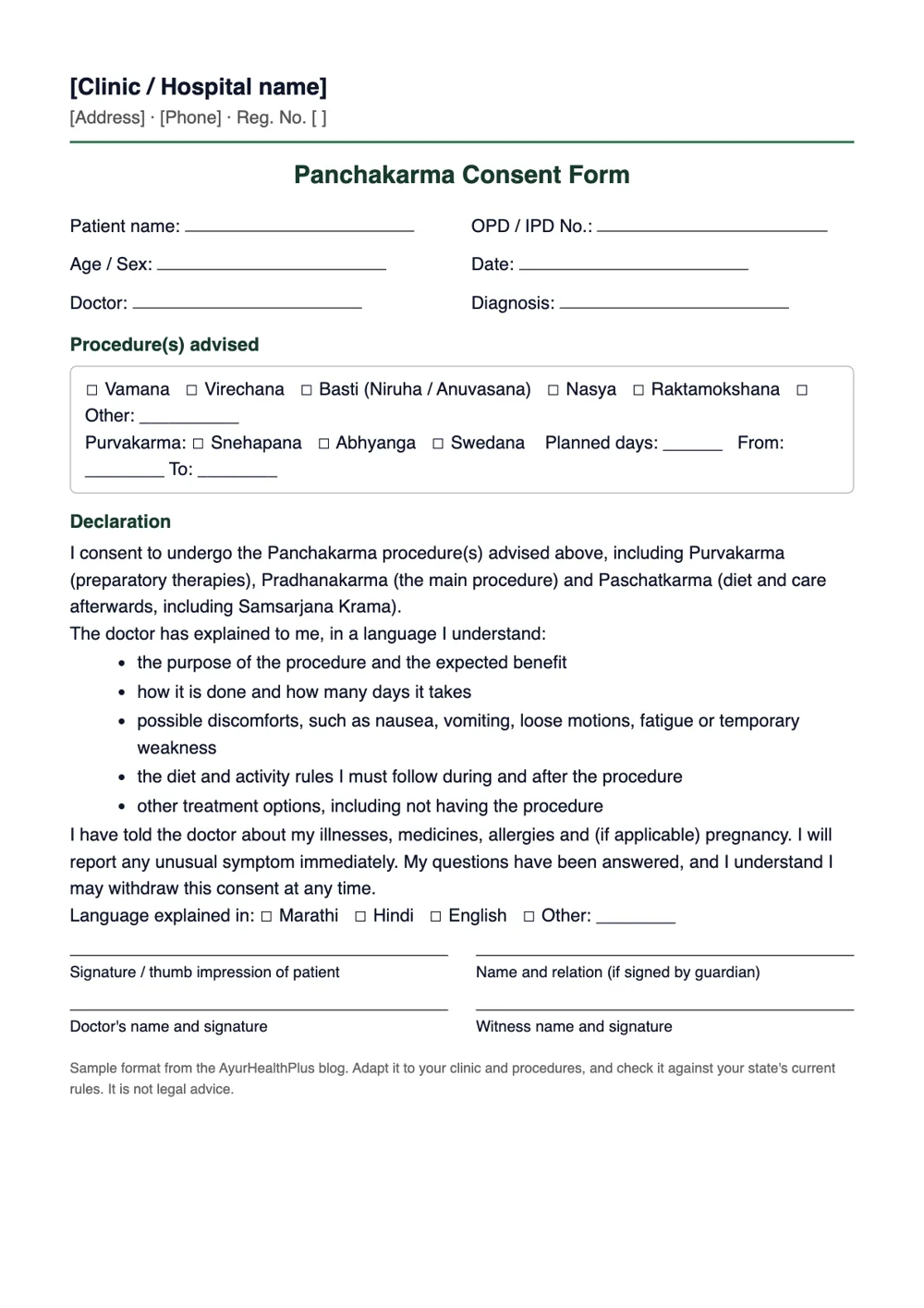
Download the free Panchakarma consent form template (PDF, A4). Add your clinic's name, and adapt the procedures and wording to your practice.
Sample consent wording
You can adapt this paragraph:
I consent to undergo the Panchakarma procedure(s) advised by my doctor, including Purvakarma (preparatory therapies such as Snehana and Swedana), Pradhanakarma (the main procedure) and Paschatkarma (diet and care afterwards). The procedure, its purpose, expected effects and possible discomforts (such as nausea, loose motions, fatigue or temporary weakness) have been explained to me. I agree to follow the diet and activity instructions and to report any unusual symptoms immediately. I understand I may withdraw consent at any time.
Translate it into Marathi or Hindi for patients who read those languages better. A form the patient can't read isn't informed consent.
When to take consent, and how often
- Before the course starts: before Snehapana or the first Purvakarma session
- Again for a new course: a second Virechana months later needs fresh consent
- Again when the form changes: if you revise the wording, take consent on the new version at the next course
- Separate forms for different things: a general treatment consent at registration, a Panchakarma consent for the course, and a therapy consent for Abhyanga or Shirodhara sessions if you take one
Common mistakes
- Taking the signature after the procedure has started
- A form in English only for a patient who reads Marathi
- Writing "risks explained" without listing them
- No witness, or no relation recorded when a guardian signs
- Losing track of which version of the form the patient signed
Keeping consent with the patient record
On paper, staple the consent to the case sheet and file it by OPD number. In software, the consent should sit in the patient's record, linked to the therapy plan, with the date, the version of the form and who gave consent.
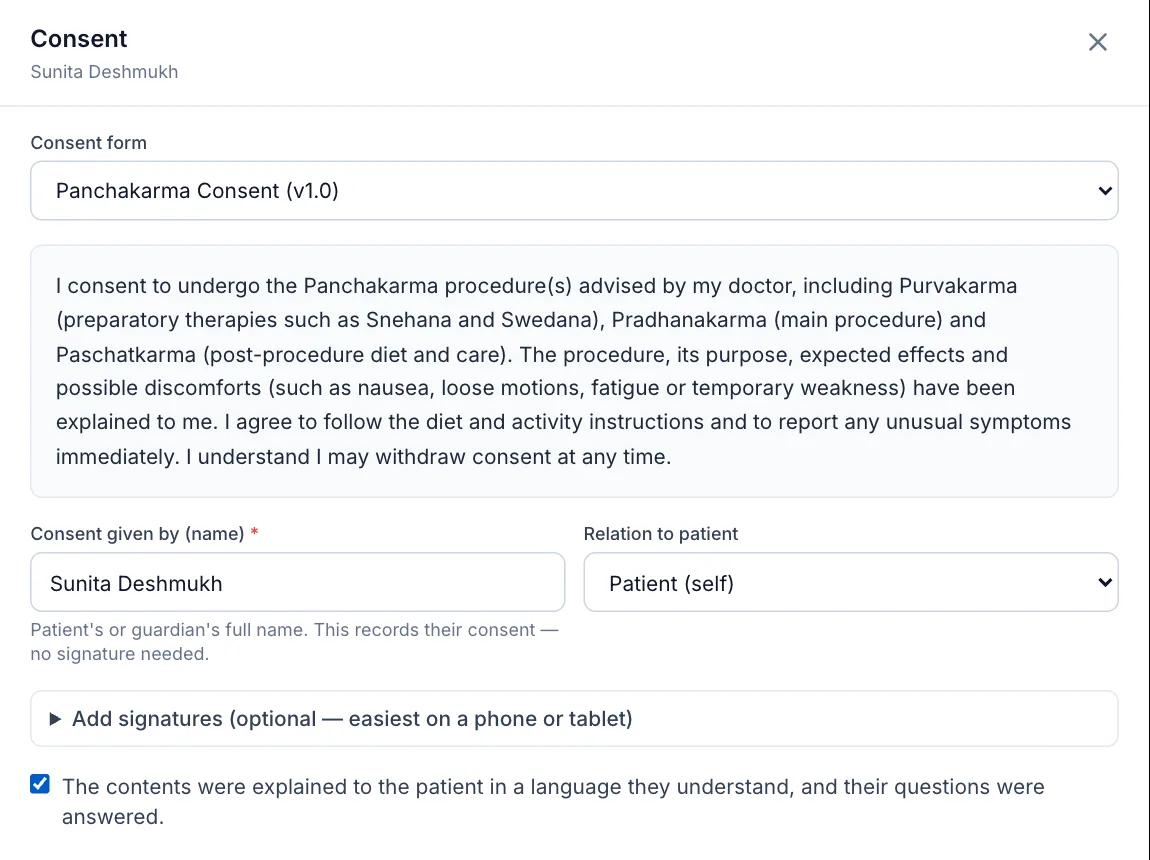
In AyurHealthPlus:
- The clinic starts with ready consent forms: general treatment, Panchakarma, procedure, therapy and teleconsultation. You can edit their wording in Settings.
- Each edit creates a new version, and every signed consent keeps the exact text the patient agreed to.
- Consent is recorded with the name and relation of the person giving it. Drawn signatures on a phone or tablet are optional.
- When a therapy plan includes Panchakarma, the software checks for a valid Panchakarma consent. If the clinic switches on mandatory consent, sessions can't be started or completed without one.
- A consent can be revoked with a reason, and it stays in the record's timeline.
See Panchakarma management software for therapy plans, scheduling and billing, or our guide to running a Panchakarma centre.
The template and sample wording are a starting point, not legal advice. Check them against your state's rules and your own procedures.
Frequently asked questions
Is a consent form required for Panchakarma?
Written informed consent is good practice for any procedure with expected discomforts, and Vamana, Virechana and Basti all have them. Check your state board's and any hospital accreditation's current requirements. A signed form also records that the explanation was given.
Who signs the Panchakarma consent form?
The patient, or a guardian if the patient is a minor or can't consent, with the relation written down. The doctor signs, and a witness signs as well.
Should the consent form be in Marathi or Hindi?
It should be in a language the patient understands. Keep translated versions of your form, and note on the form which language was used.
When should Panchakarma consent be taken?
Before the first preparatory therapy, such as Snehapana, not on the day of the main procedure. Take it again for a new course or after you change the form.
Can consent be recorded in clinic software?
Yes. AyurHealthPlus records consent in the patient's file with the form version, date and the name of the person giving it. It can block Panchakarma sessions until consent is on file.