
Ayurvedic Case Sheet Format (Case Paper) – Free PDF for BAMS Doctors
25 October 2026 · AyurHealthPlus
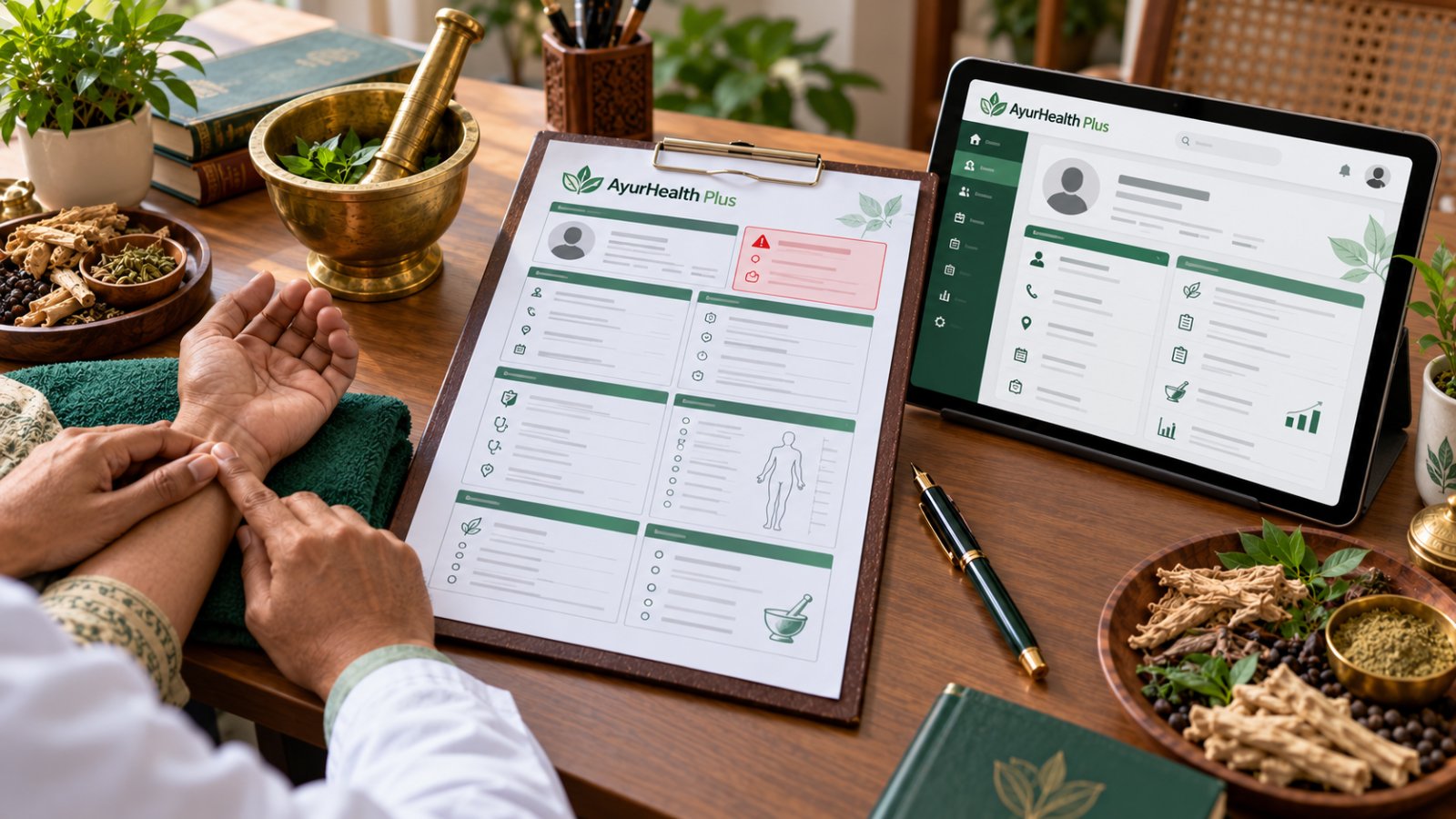
Free printable Ayurvedic case sheet format (PDF) for BAMS doctors, with a section-by-section guide: vitals, Ashtavidha Pariksha, Prakriti, Samprapti, Anupana.
The case paper is the most important document in an Ayurvedic OPD. It decides whether the next visit starts from where you left off, whether a Panchakarma plan is safe, and whether you can defend your treatment if anyone ever asks. Yet most clinics use a format that was copied years ago and never revised — too short for a chronic patient, too long for a busy OPD.
This guide lays out a complete Ayurvedic case sheet format (also called the case paper), section by section, with what to record in each and why. Use it to review your own printed case paper, or as a checklist while you examine.
Download the free Ayurvedic case sheet PDF: two A4 pages, blank and ready to print, with space for your clinic letterhead. It follows the same 10 sections as this guide.
Ayurvedic case sheet format: the 10 sections
1. Patient registration
- Name, age, gender, mobile number and address
- A clinic OPD / registration number that stays the same for every visit
- Occupation and education (they shape diet, routine and stress)
- Date of the visit and the next follow-up date
Tip: one patient, one OPD number. Every visit, prescription and bill should be filed under it, so the patient's history is never split across papers.
2. Vitals — and allergies at the top
- Weight, height, BP, pulse, temperature, SpO2
- Blood sugar (RBS / FBS) — many Ayurvedic patients are diabetic or pre-diabetic and it changes your choice of formulation and Anupana
- Drug and food allergies, written where nobody can miss them — ideally in a box at the top of the case paper, not buried on page two
3. Chief complaints and present illness
- Each complaint with its duration
- Onset and course — sudden or gradual, continuous or intermittent
- Aggravating and relieving factors (cold, food, time of day, exertion, rest, fomentation)
- Treatment already taken and its effect
Aggravating and relieving factors are often skipped on paper, yet they point straight to the Dosha involved. Give them their own line.
4. Past, family and personal history
- Past illnesses and surgeries (DM, HTN, thyroid, injuries)
- Family history — father's side, mother's side, hereditary illness
- Addictions — tea, tobacco, gutkha, smoking, alcohol
- For women: menstrual history (cycle, flow, pain, clots) and obstetric history
5. Daily routine and diet (Dinacharya and Ahara)
- Wake-up time, morning drink, exercise, bath water, nature and timing of work
- Appetite and meal regularity
- Water intake — quantity, timing, fridge or matka
- Stale food, bakery and junk food, and Viruddha Ahara (incompatible combinations such as milk with fish or fruit)
6. Mala, Mutra, Sweda and Nidra
- Bowel: frequency, consistency, blood or mucus
- Urine: day and night frequency, colour, burning
- Sweat: when, odour, sweaty palms and soles
- Sleep: bedtime, quality, hours, day sleep
These four lines are the easiest to forget and among the most useful at the follow-up visit.
7. Ayurvedic examination
- Ashtavidha Pariksha: Nadi, Mala, Mutra, Jihva, Shabda, Sparsha, Drik, Akriti
- Dashavidha Pariksha: Prakriti, Vikriti, Sara, Samhanana, Pramana, Satmya, Sattva, Ahara Shakti, Vyayama Shakti, Vaya
- Agni (Sama, Manda, Tikshna, Vishama) and Koshtha (Mridu, Madhyama, Krura)
- General and systemic examination — heart, lungs, abdomen, joints
8. Diagnosis
- Dosha, Dushya and Avastha (Sama / Nirama, acute / chronic)
- Samprapti — even one line ("Mithya Ahara → Agnimandya → Ama → Srotorodha")
- Ayurvedic diagnosis and the modern diagnosis side by side
- Sadhya-Asadhyata (prognosis)
- Investigations advised and their results
9. Chikitsa (treatment)
- Chikitsa Sutra — the treatment principle
- Each formulation with dose, timing, Anupana and duration
- Panchakarma or local therapy advised, with the number of days
- Pathya–Apathya — the diet and lifestyle advice the patient takes home
A prescription without Anupana is incomplete in Ayurveda. If your case paper has no column for it, add one.
10. Follow-up
- Next visit date
- What to compare at the follow-up — symptoms, Nadi, Agni, bowel, sleep, weight, sugar
- Changes made to the treatment, and why
Common case sheet mistakes
- No space for Anupana or Pathya–Apathya — so they are told verbally and forgotten.
- Allergies written in small print in the middle of the page.
- A new paper at every visit with no link to the previous one.
- The same long format for every patient — a full case sheet for a 2-day cold wastes time; a one-line note for a chronic Amavata patient loses the history.
- Illegible handwriting that even the doctor can't read six months later.
How AyurHealthPlus fills this case paper for you
We built AyurHealthPlus around exactly this format, because writing a complete Ayurvedic history by hand on a busy day is where most case papers get cut short.
- Speak, don't write. Talk to the patient in Marathi, Hindi or English as usual. The AI history taking listens and fills the case paper — complaints, duration, aggravating and relieving factors, urine, bowel, sleep, routine, allergies and vitals — each in its own field. You check and correct everything before saving; the AI never diagnoses or prescribes.
- Two formats, your choice per patient. A quick Simple History for routine OPD patients, and the full Ayurvedic case sheet with Ashtavidha Pariksha, Prakriti, Agni, Koshtha and Samprapti for new and chronic cases.
- Allergy alert on every page. A red allergy box at the top of the screen and at the top of the printed case paper.
- Prescriptions with Anupana and Pathya–Apathya. One-tap classical formulations, your own treatment kits, and the medicines in your clinic stock — see Ayurvedic prescription software.
- Print the way you like. The full case sheet, only the filled sections, or just the prescription — on your own letterhead. You can even print a blank case paper in the same format for handwritten notes.
- Every visit on one patient record. Search by name, OPD number or mobile and see every previous case paper on a timeline — the follow-up starts where you left off. This is what an Ayurveda EMR does.
- Panchakarma follows from the case paper. Therapy advised in the history carries into the Panchakarma plan — sessions, room, therapist and consent.
It runs in a browser on a computer, tablet or phone, in Marathi, Hindi and English, with patient records encrypted and each clinic's data kept separate.
Try it on your next 5 patients
Start the 1-month trial, set up your letterhead, and take your next five OPD case histories by voice. Compare the case paper you get with the one you write by hand today.
See the plans or start the trial from the homepage.
Written by the AyurHealthPlus team for BAMS and MD (Ayurveda) doctors. Questions? WhatsApp +91 72768 90399 or email support@ayurhealthplus.in.