
Panchakarma Therapy Record Sheet: Format and Free PDF
24 November 2026 · AyurHealthPlus
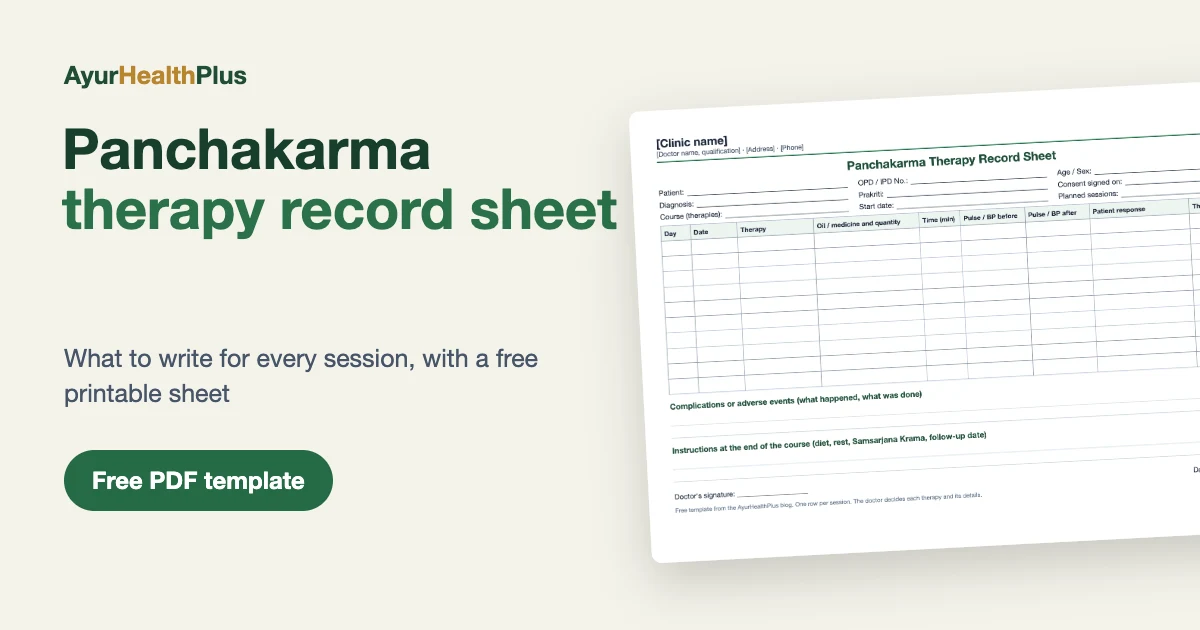
What to write for every Panchakarma session: therapy, oil and quantity, time, vitals before and after, response and therapist. With a free printable sheet.
Short answer: A Panchakarma therapy record sheet has one row for every session. Each row holds the date, the therapy, the oil or medicine and its quantity, the time taken, pulse and BP before and after, how the patient responded, and who gave it. At the top, write the patient's details, diagnosis, the planned course and the date consent was signed. At the bottom, record any complication and the instructions given when the course ends.
This guide is for Ayurvedic doctors, Panchakarma centres and therapists. It includes a free printable Panchakarma therapy record sheet (PDF).
Key points
- Write the record during or right after the session, not at the end of the day.
- Record the oil or Kashaya by name and quantity, for example "Mahanarayan Taila, 120 ml".
- Take pulse and BP before and after, especially for Shirodhara, Swedana and the main Shodhana procedures.
- Note the patient's response in their own words where you can.
- Record complications even when they are minor, along with what was done.
Why keep a record of every session?
A course of Abhyanga, Swedana, Basti or Virechana runs over many days, often with different therapists. Without a daily record, nobody can tell on day 5 how the patient did on day 2, or which oil was used. The sheet helps the doctor adjust the course, and it is the clinic's proof of what was done if a patient later has a question or complaint.
What should a Panchakarma record sheet include?
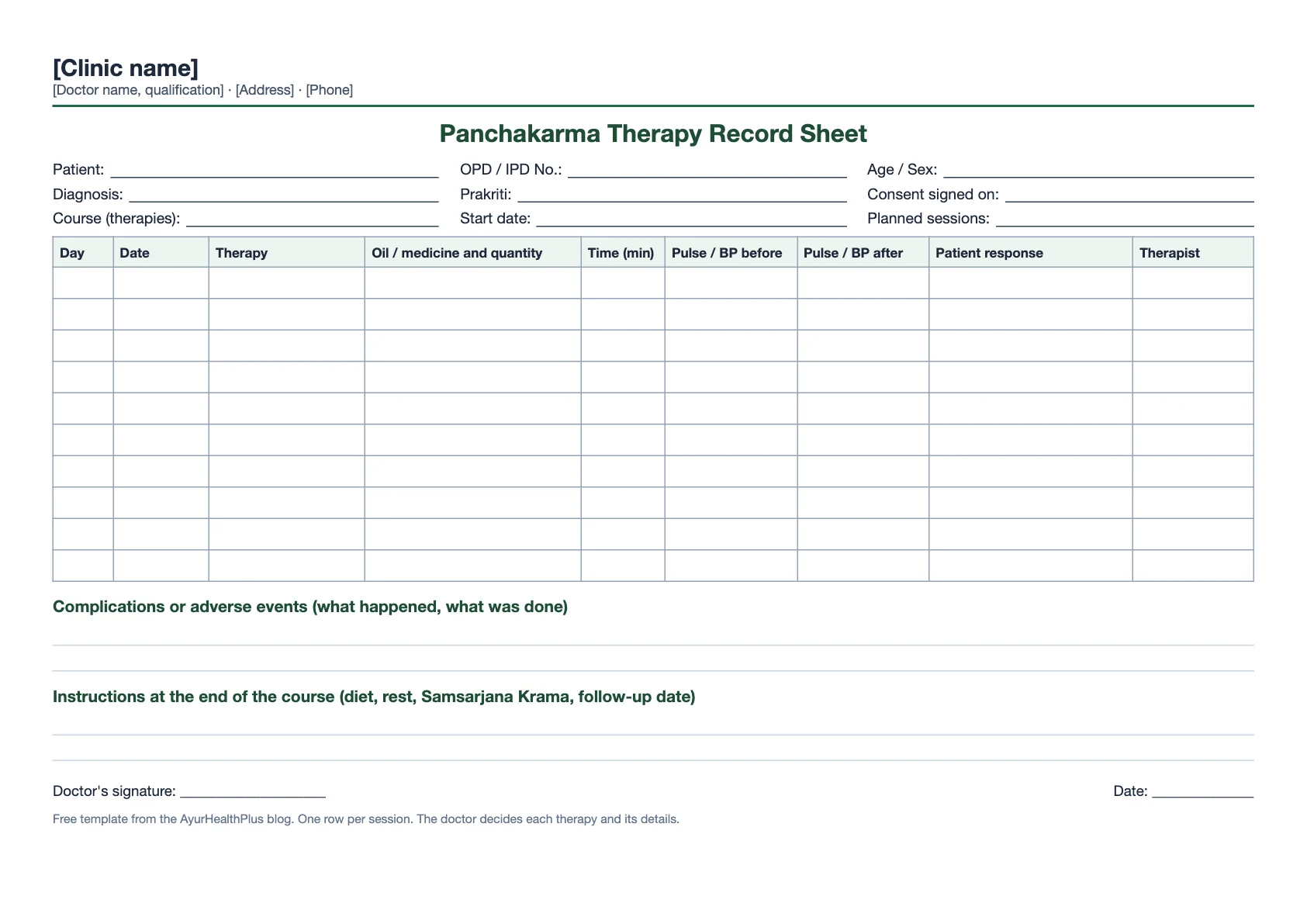
At the top (once per course)
- Patient name, OPD or IPD number, age and sex
- Diagnosis and Prakriti
- The therapies planned, start date and number of sessions
- The date the consent form was signed (see our Panchakarma consent form format)
For each session (one row)
- Day number and date
- Therapy given, for example Abhyanga, Bashpa Sweda, Kati Basti
- Oil, Kashaya or medicine, with the quantity
- Time taken in minutes
- Pulse and BP before
- Pulse and BP after
- Patient response: comfort, sweating, any discomfort
- Therapist's name or initials
At the end of the course
- Complications or adverse events: what happened and what was done
- Instructions given: diet, rest, Samsarjana Krama, follow-up date
- Doctor's signature and date
A filled example
Day 1, Abhyanga + Bashpa Sweda. Mahanarayan Taila 120 ml, warm, 35 minutes, then Sweda 10 minutes. Before: pulse 78, BP 128/82, morning stiffness in both knees. After: pulse 74, BP 124/80, knee movement easier. Response: relaxed, mild sweating on forehead and chest. Instructions: warm water bath after an hour, light warm food, no cold drinks.
These are example entries. The therapy, oil, quantity and duration are the doctor's decision for each patient.
Common mistakes
- Writing only "Abhyanga done". That says nothing about the oil, the quantity or how the patient was.
- Vitals only on day 1. Changes show up later in the course, so take them every session.
- No therapist name. When several therapists work, you can't ask the right person what happened.
- Leaving out small reactions. Mild giddiness or nausea that is not written down can't be compared on the next day.
- Separate papers for consent, sessions and bills. Keep them together with the patient's case paper.
Download the free template
Download the free Panchakarma therapy record sheet (PDF, A4 landscape). It has 10 session rows per page; print a second page for longer courses.
Keeping the record in AyurHealthPlus
In AyurHealthPlus, each session in a therapy plan has its own record. The therapist or doctor fills it on the session itself:
- A checklist: consent verified, vitals checked, oil or medicine prepared, room ready
- Before the procedure (pulse, BP, how the patient feels), procedure notes (oil, method, time), patient response, after the procedure, and instructions given
- Purvakarma, Pradhanakarma and Paschatkarma notes for Panchakarma procedures
- A tick box for any complication, with space to describe what happened and what was done
- A reminder when the consent form for the therapy has not been signed
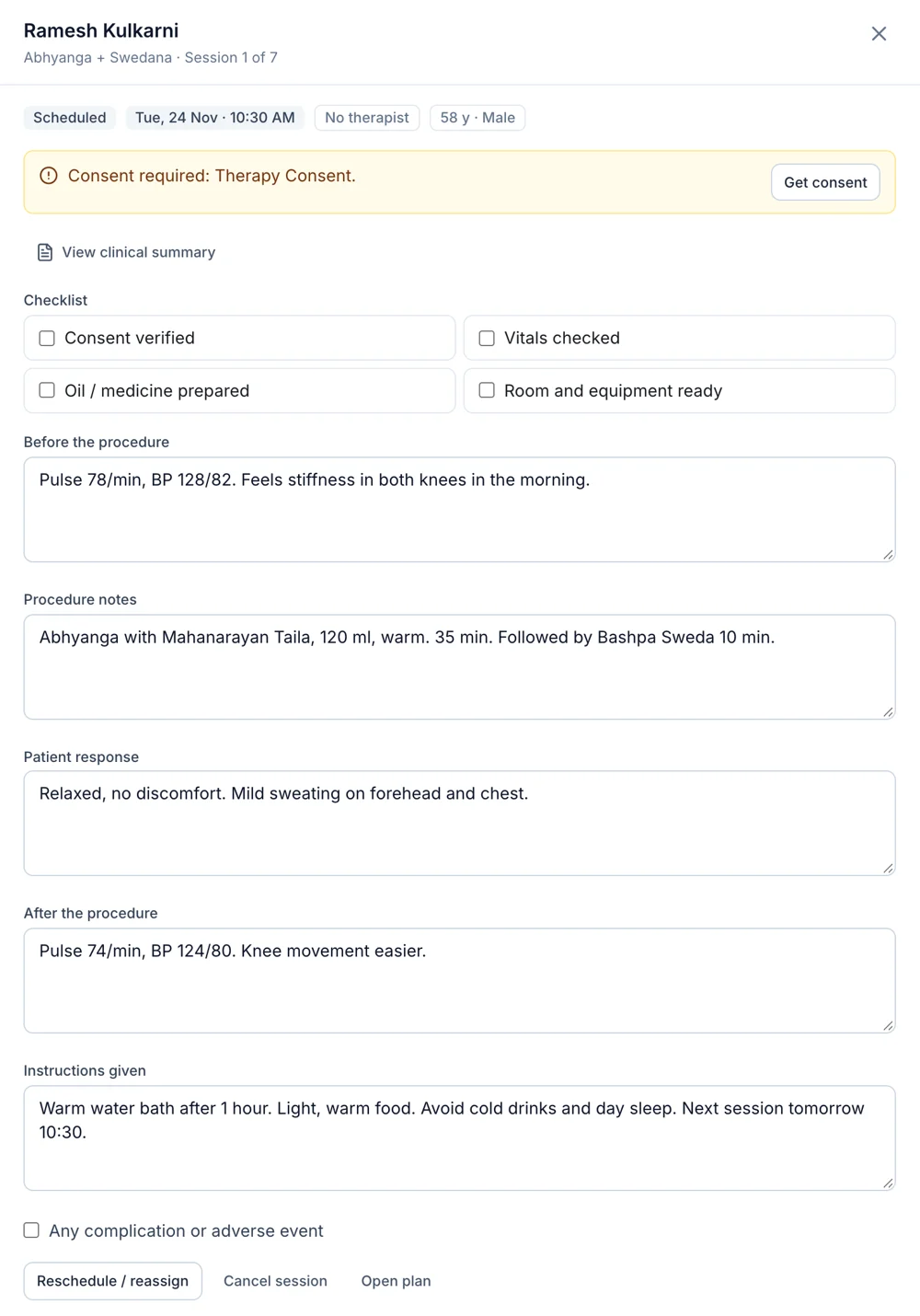
The session shows "Session 1 of 7", so everyone can see where the patient is in the course. Notes are stored encrypted, and only the doctor can correct a completed session. See Panchakarma centre management for scheduling rooms and therapists, and Ayurvedic clinic management software for the full system.
Frequently asked questions
What is a Panchakarma therapy record sheet?
It is a sheet with one row for each Panchakarma or therapy session, recording the date, therapy, oil and quantity, time, vitals before and after, the patient's response and the therapist.
Should pulse and BP be taken at every session?
It is good practice to take them before and after every session, especially for Shirodhara, Swedana and the main Shodhana procedures, so that changes during the course are noticed.
Who fills the therapy record sheet?
The therapist who gives the session usually fills the row, and the doctor reviews it and signs at the end of the course.
How long should Panchakarma records be kept?
Keep them with the patient's case paper for as long as you keep other clinical records. Check the rules that apply in your state.
Is there a free Panchakarma record sheet format?
Yes. Download our free Panchakarma therapy record sheet (PDF) and print it for each course.