
Prakriti Assessment: Recording Prakriti and Dashavidha
19 November 2026 · AyurHealthPlus
How to assess and record Prakriti in the OPD, what to note for each part of Dashavidha Pariksha, and how Agni, Koshtha and Samprapti fit in.
Short answer: Prakriti is the patient's inborn constitution: Vata, Pitta, Kapha, a combination of two, or Sama (all three balanced). Assess it from features that have been stable since childhood, such as build, skin, hair, appetite, sleep, temperament and tolerance of heat and cold, not from the current illness. Record it as the dominant Doshas, for example "Vata-Pitta Prakriti". Then record Vikriti (the current Dosha imbalance) and the other parts of Dashavidha Pariksha separately, so the constitution and the disease are never mixed up.
This guide shows Ayurvedic doctors how to assess and write the constitution, Dashavidha Pariksha, Agni and Koshtha in an OPD case sheet.
Key points
- Prakriti doesn't change; Vikriti does. Record them in separate fields.
- Ask about lifelong traits, not this month's symptoms.
- Dual Prakriti (Vata-Pitta, Vata-Kapha, Pitta-Kapha) is common. Record both Doshas, with the stronger one first.
- Agni and Koshtha decide dose and procedure, so record them every time.
How to assess Prakriti in the OPD
Ask about features that have been the same for most of the patient's life:
- Body: build, weight gain or loss, joints, skin (dry, warm, oily), hair
- Digestion: appetite, thirst, tolerance of skipped meals
- Sleep: light or deep, how many hours
- Climate: tolerance of heat and cold
- Mind: speed of learning and forgetting, temperament, reaction to stress
- Activity: energy, stamina, speech, walking pace
Mostly Vata features (thin, dry skin, light sleep, quick but variable) suggest Vata. Mostly Pitta features (medium build, warm skin, strong appetite, sharp, irritable) suggest Pitta. Mostly Kapha features (heavy build, oily skin, deep sleep, steady, slow to start) suggest Kapha. Most patients show two.
A structured questionnaire helps when you are learning, but your observation in the clinic counts as much as the patient's answers.
How to write Prakriti in the case sheet
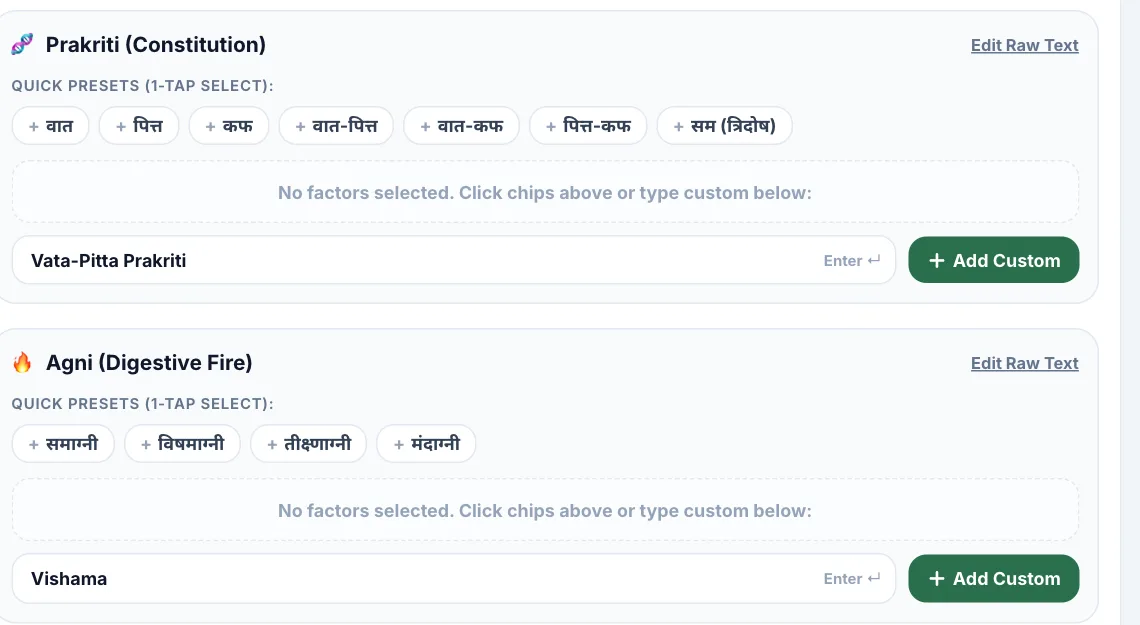
Write the dominant Doshas, stronger one first: "Vata-Pitta Prakriti". If one is clearly dominant, write that one alone: "Kapha Prakriti". Avoid "Tridoshaja" unless all three really are balanced (Sama Prakriti is uncommon).
Dashavidha Pariksha: what to record
Dashavidha Pariksha, the ten-fold examination described in Charaka Samhita, assesses the patient's constitution and strength before treatment:
- Prakriti: constitution, as above
- Vikriti: the current Dosha imbalance and the disease
- Sara: quality of the Dhatus (Pravara, Madhyama, Avara)
- Samhanana: compactness of the body
- Pramana: body measurements, proportions
- Satmya: what the patient is used to (foods, climate, habits)
- Sattva: mental strength
- Ahara Shakti: capacity to take in and digest food
- Vyayama Shakti: capacity for exercise
- Vaya: age group (Bala, Madhya, Vriddha)
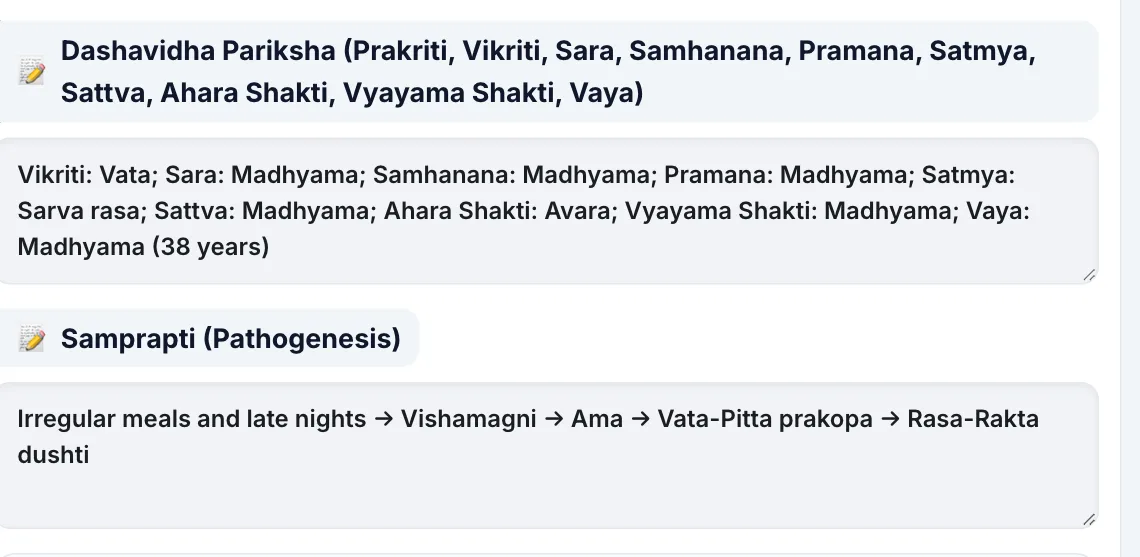
For most parts, a grade of Pravara (good), Madhyama (medium) or Avara (low) is enough. Example: Vikriti: Vata; Sara: Madhyama; Samhanana: Madhyama; Sattva: Madhyama; Ahara Shakti: Avara; Vyayama Shakti: Madhyama; Vaya: Madhyama (38 years).
Agni and Koshtha
- Agni: Sama, Vishama, Tikshna or Manda. It guides the dose of medicines and whether Deepana-Pachana comes first.
- Koshtha: Mridu, Madhyama or Krura. It decides the purgative and dose for Virechana.
Record both at every visit before Panchakarma, because they change.
From assessment to Samprapti
With Prakriti, Vikriti, Agni, Koshtha, Dosha and Dushya recorded, the Samprapti can be written as a chain, for example: irregular meals → Vishamagni → Ama → Vata-Pitta prakopa → Rasa-Rakta dushti. The Chikitsa Sutra follows from it. The Ashtavidha Pariksha format covers the eight-fold examination that feeds into this assessment.
Common mistakes
- Recording the current illness as the constitution, for example "Pitta Prakriti" for a patient with acidity this month
- Writing only Prakriti and skipping Vikriti
- Not recording Agni and Koshtha before Virechana
- Free-text notes that can't be compared at the next visit
Recording Prakriti in AyurHealthPlus
The Ayurvedic Clinical Assessment module of AyurHealthPlus has separate fields for:
- Dosha, Dushya and Prakriti
- Agni, Koshtha and the stage (Avastha)
- Dashavidha Pariksha and Samprapti
- The treatment principle
Each field has one-tap chips (for example Vata-Pitta, or Vishamagni) and a custom entry, with labels in Marathi, Hindi and English. The doctor can also speak the consultation and let AI draft the case sheet, then review every field before saving. AI is part of the Pro and Premium plans and the trial. See Ayurvedic diagnosis software and Ayurvedic history taking software.
Frequently asked questions
How is Prakriti determined in Ayurveda?
By examining features that have been stable since birth: body build, skin, hair, digestion, sleep, tolerance of heat and cold, temperament and activity. Each feature points to Vata, Pitta or Kapha, and the dominant Doshas give the Prakriti.
Can Prakriti change?
No. Prakriti is fixed at conception. What changes is Vikriti, the current imbalance, which is why the two are recorded separately.
What is the difference between Prakriti and Vikriti?
Prakriti is the patient's natural constitution. Vikriti is the present state of imbalance or disease. Treatment aims to correct Vikriti while respecting Prakriti.
What are the 10 parts of Dashavidha Pariksha?
Prakriti, Vikriti, Sara, Samhanana, Pramana, Satmya, Sattva, Ahara Shakti, Vyayama Shakti and Vaya.
Is there software to record Prakriti?
Yes. AyurHealthPlus has structured fields for Prakriti, the Doshas involved, Dashavidha Pariksha, Agni, Koshtha and Samprapti in its Ayurvedic case sheet.