
Ashtavidha Pariksha Format: How to Record All 8 Exams
19 November 2026 · AyurHealthPlus
A practical Ashtavidha Pariksha format for the OPD: what to record for Nadi, Mala, Mutra, Jihva, Shabda, Sparsha, Drik and Akriti, with example entries.
Short answer: Ashtavidha Pariksha is the eight-fold examination of the patient in Ayurveda: Nadi (pulse), Mala (stool), Mutra (urine), Jihva (tongue), Shabda (voice), Sparsha (touch), Drik (eyes) and Akriti (build). For each one, record a short, specific finding, such as "Jihva: white coating at the back, Sama", not just "normal". Record it at the first visit and again at follow-ups, so you can see whether Ama, Agni and the Dosha picture are changing.
This guide is for BAMS students, interns and practising Ayurvedic doctors who want a quick, consistent way to record the eight examinations in a busy OPD.
Key points
- It is a Rogi Pariksha: it examines the patient, and supports the diagnosis.
- Each of the eight takes a minute or less, so it fits a normal OPD visit.
- Write findings, not ticks: what you saw, felt or heard, and whether it points to Sama or Nirama.
- Repeat the examination at follow-ups and compare it with the first visit.
Ashtavidha Pariksha format at a glance
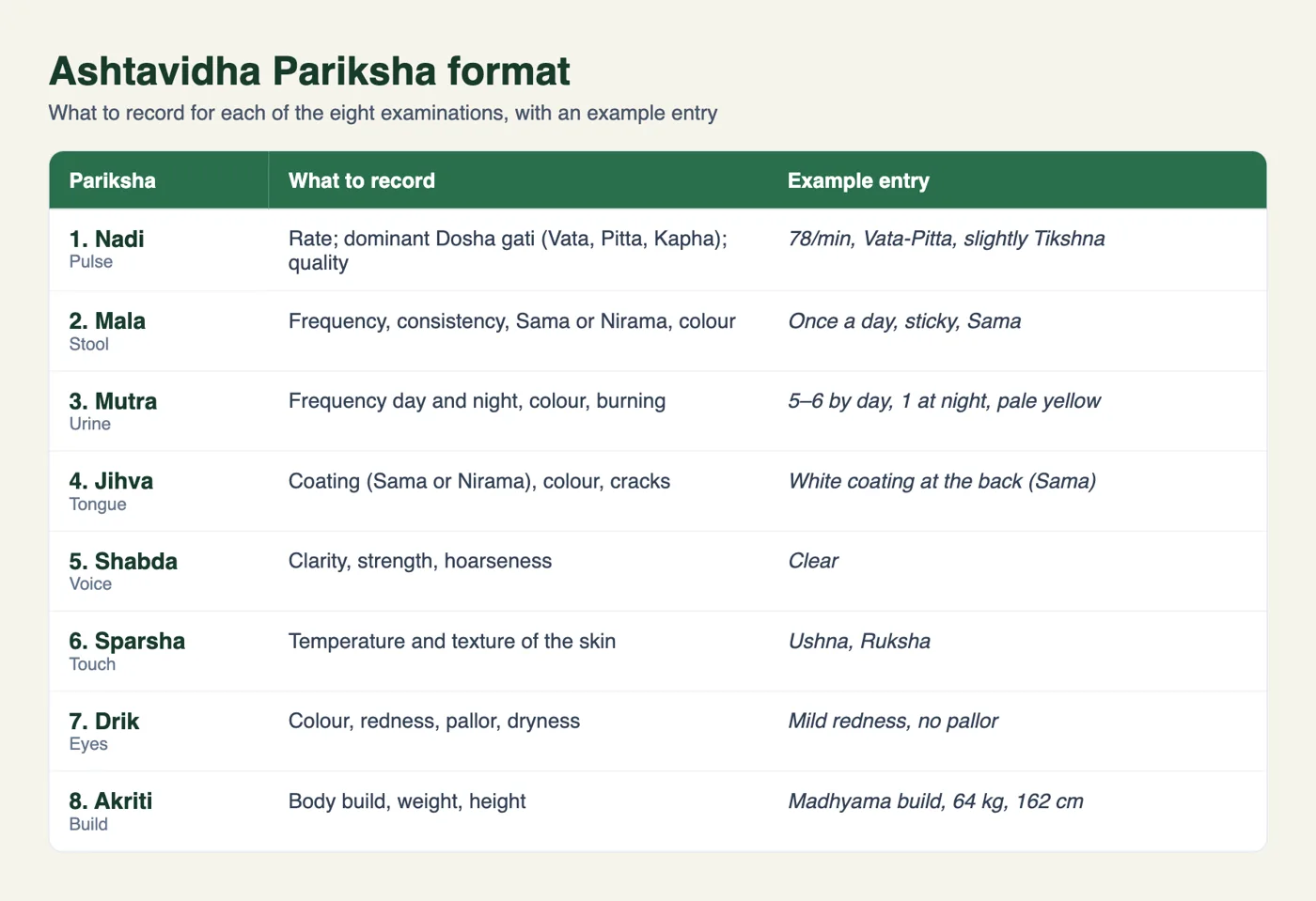
What to record for each Pariksha
1. Nadi (pulse)
Record the rate, the dominant gati (Vata, Pitta or Kapha, or a combination) and the quality, such as Tikshna, Manda or weak. Example: 78/min, Vata-Pitta, slightly Tikshna. Note the time, because the pulse changes after meals and exercise.
2. Mala (stool)
Ask about frequency, time taken, consistency (hard, soft, loose, sticky), whether it floats or sinks, and the smell. Sticky, foul-smelling stool that sinks suggests Sama Mala. Example: Once a day, sticky, sinks, Sama.
3. Mutra (urine)
Record how often by day and by night, the colour, burning, and any change in quantity. Example: 5–6 times by day, once at night, pale yellow, no burning.
4. Jihva (tongue)
Look at the coating, the colour, cracks and the edges. A thick coating, especially at the back, suggests Ama (Sama Jihva). A clean tongue suggests Nirama. Example: White coating at the back, Sama.
5. Shabda (voice)
Note whether the voice is clear, weak, heavy or hoarse, and anything notable in speech. Example: Clear, normal strength.
6. Sparsha (touch)
Feel the skin for temperature (Ushna or Sheeta) and texture (Ruksha or Snigdha), and note tenderness. Example: Ushna, Ruksha.
7. Drik (eyes)
Look for redness, yellowness, pallor and dryness. Example: Mild redness, no pallor, no icterus.
8. Akriti (build)
Record body build, weight and height, and anything visible about the patient's appearance. Example: Madhyama build, 64 kg, 162 cm.
How to make it fast in the OPD
- Use short fixed phrases. "Sama", "Nirama", "Ushna", "Ruksha" are quicker to write and compare than sentences.
- Do it in the same order every time, so nothing is skipped.
- Record "normal" only after you have actually checked. A blank is better than a guessed "NAD".
- Ask Mala and Mutra questions while taking the history, and examine the rest at the table.
- Compare at follow-up. A tongue that changes from Sama to Nirama tells you the Amapachana worked.
Where it fits in the case sheet
The eight-fold examination sits in the case sheet after the history and before the assessment. Its findings feed into Dashavidha Pariksha, Prakriti, Agni and Koshtha, and then into the Samprapti and Chikitsa. See our Ayurvedic case paper format for the full case sheet, and Prakriti assessment for recording Prakriti and Dashavidha Pariksha.
Recording the eight examinations in software
In paper case sheets, these findings often end up as a few words in the margin, which are hard to compare later. AyurHealthPlus records them in structured fields:
- Nadi, Jihva, Shabda, Sparsha, Drik and Akriti (weight, height, BP) in the Physical Examination module, with one-tap chips such as Vata Nadi or Pitta Nadi
- Mala and Mutra in the Bowel, Urination and Sweating module: frequency, consistency, whether the stool floats, urine colour, burning
- A Mark all normal button, then you change only the abnormal findings
- Labels in Marathi, Hindi and English
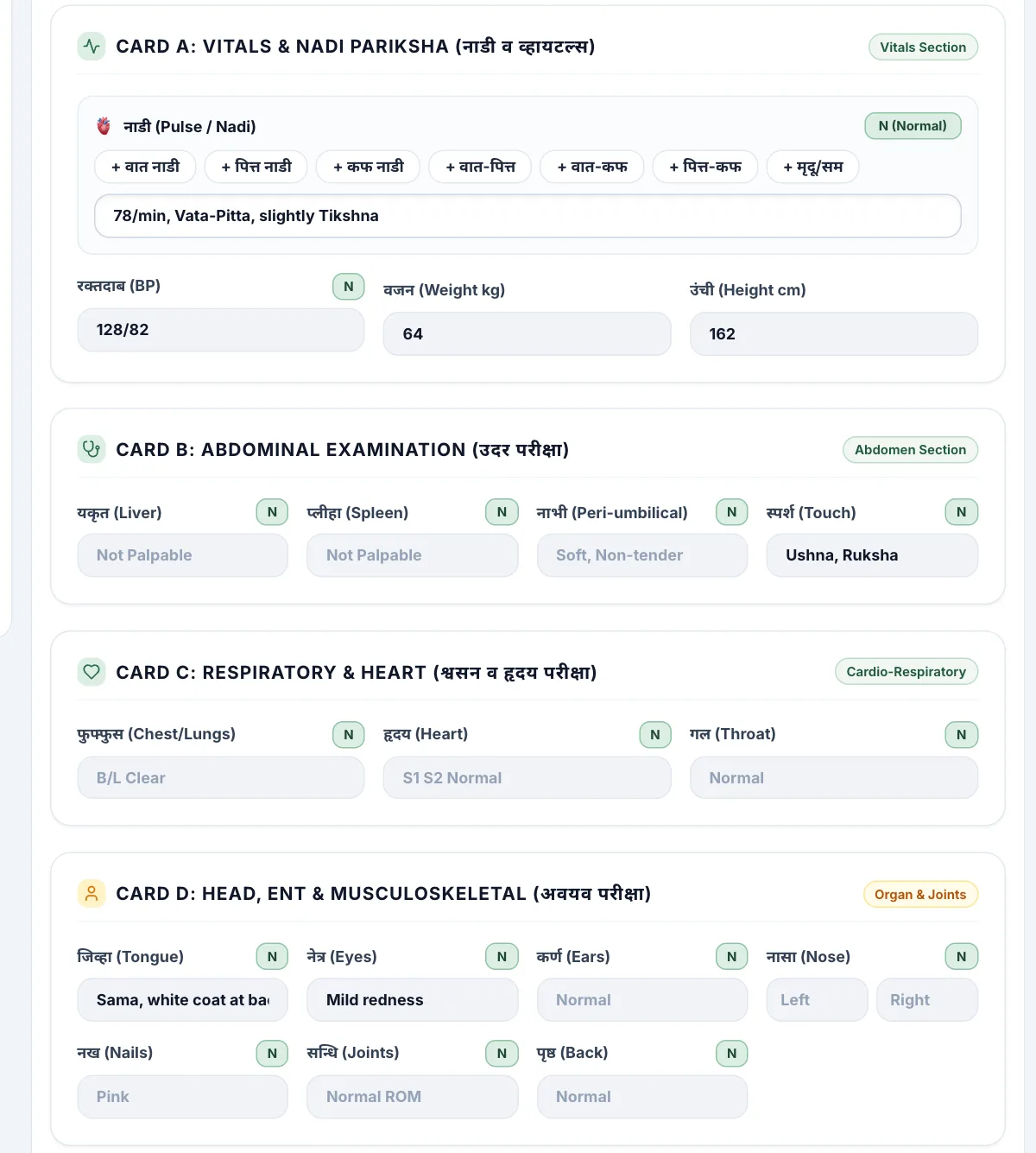
Every visit is saved to the patient's record, so you can compare findings across follow-ups. See Ayurvedic history taking software for the full 18-module case sheet.
Frequently asked questions
What are the 8 parts of Ashtavidha Pariksha?
Nadi (pulse), Mala (stool), Mutra (urine), Jihva (tongue), Shabda (voice), Sparsha (touch), Drik (eyes) and Akriti (build or appearance).
Who described Ashtavidha Pariksha?
It is described in Yogaratnakara, a later classical text. The Brihat Trayi describe other methods of examination, such as Dashavidha Pariksha in Charaka Samhita.
What is the difference between Ashtavidha and Dashavidha Pariksha?
Ashtavidha Pariksha is an eight-fold examination of the patient's current state. Dashavidha Pariksha is a ten-fold assessment, including Prakriti, Vikriti, Sara and Bala, to judge the patient's constitution and strength before treatment.
How do you write Jihva Pariksha in a case sheet?
Write the coating, its location, colour and any cracks, then whether it suggests Sama or Nirama. Example: "White coating at the back, Sama".
Can the eight-fold examination be recorded in software?
Yes. AyurHealthPlus has structured fields for all eight across its Physical Examination and Bowel, Urination and Sweating modules, in Marathi, Hindi and English.