
Daily OPD Register Format for Ayurvedic Clinics (Free Printable PDF)
17 November 2026 · AyurHealthPlus
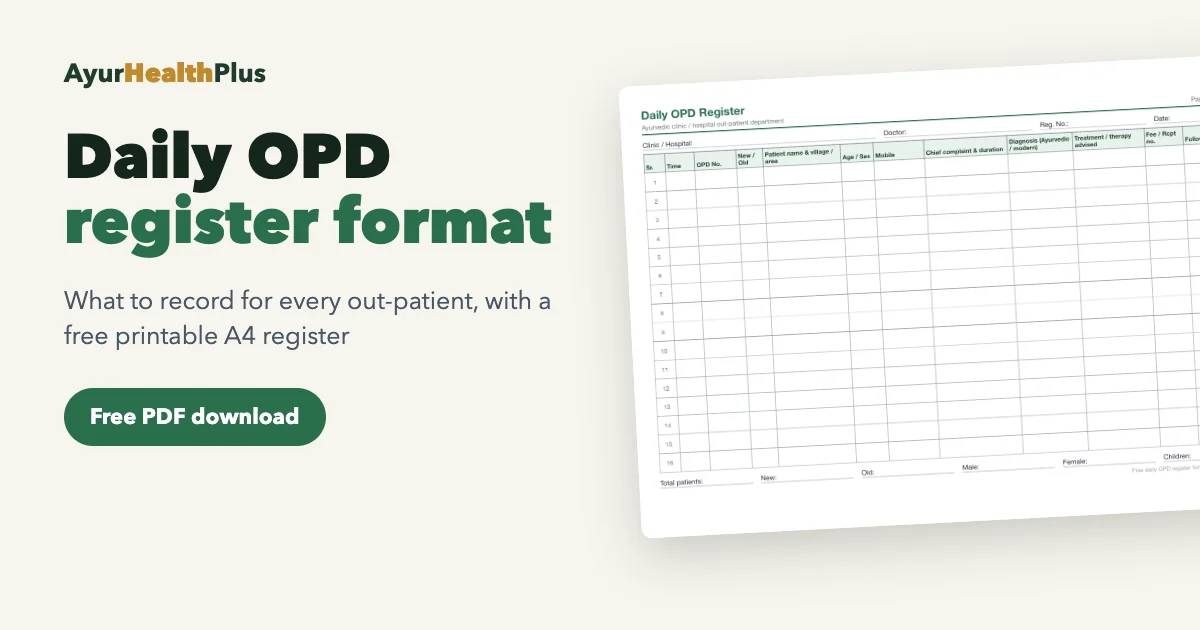
A daily OPD register format for Ayurvedic clinics and hospitals: what to record for every out-patient, how to count daily OPD, and a free printable A4 PDF.
Every Ayurvedic OPD keeps a daily register, whether it is a notebook on the reception desk or a column in a computer. It is the one record that lists every out-patient seen on a given day. On a good day it is a formality. When you need to find a patient from last March, count new patients for the month, or show daily OPD figures to an inspector, it is the most important book in the clinic.
This guide gives a simple daily OPD register format for Ayurvedic clinics and hospitals: what each column is for, how to count the day's OPD, and a free printable A4 register you can use from tomorrow.
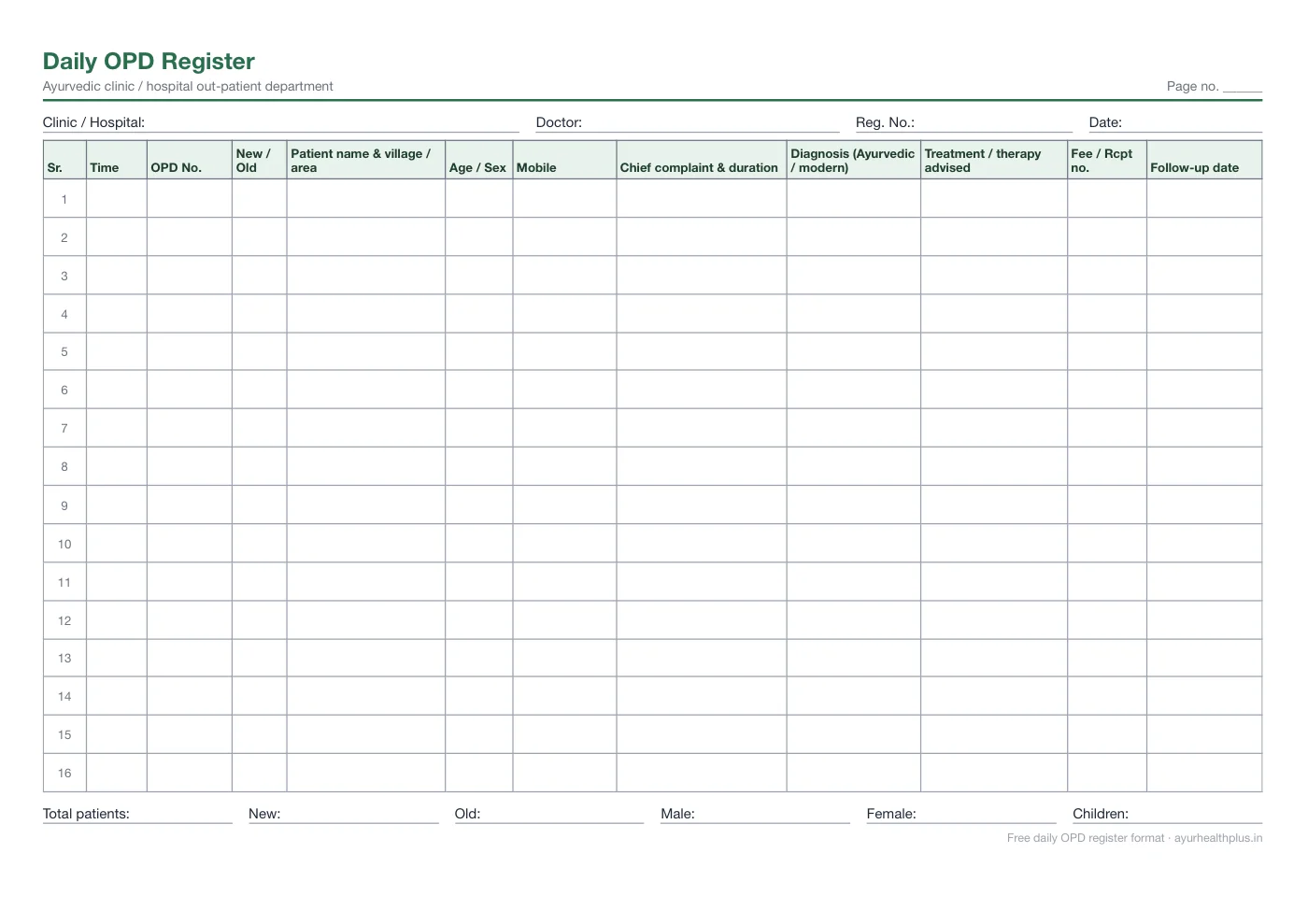
Download the free daily OPD register (PDF): one A4 landscape page with 16 patients per page. Print as many copies as you need.
What a daily OPD register should record
Each row is one patient visit. These 12 columns cover what most Ayurvedic clinics and hospitals need:
- Sr. No. Numbering restarts every day. The last number is your day's OPD count.
- Time. Shows the busy hours, and helps when two patients have the same name.
- OPD No. The patient's permanent clinic number. The same number on every visit links the register to the case paper.
- New / Old. Is this the patient's first visit or a follow-up? You will need this count every day.
- Patient name and village or area. Area helps tell apart patients with the same name, and shows where your patients come from.
- Age / Sex. Needed for the daily totals of male, female and child patients.
- Mobile. Lets you find the patient again and call about follow-ups.
- Chief complaint and duration. In a few words, for example "Acidity, 10 days".
- Diagnosis. The Ayurvedic diagnosis (for example Amlapitta), and the modern one if relevant.
- Treatment or therapy advised. Medicines in short, and any Panchakarma or local therapy advised.
- Fee / receipt no. Matches the register to the day's collection.
- Follow-up date. The date the patient should return. It turns the register into a recall list.
The full history, examination and prescription belong on the case paper, not in the register. The register is an index that tells you which case paper to open. For the case paper itself, see our Ayurvedic case paper format.
How to count the daily OPD
At the end of the day, fill the totals line at the bottom of the page:
- Total patients: the last Sr. No. of the day
- New and old: count the New / Old column
- Male, female and children: from the Age / Sex column
Add each day's totals to a monthly summary sheet. The monthly figures show whether new patients are growing, how many follow-ups actually come back, and which days need an extra hand at the desk. Ayurveda college hospitals and hospitals that are inspected are often asked for these daily and monthly OPD figures. Keeping them every day saves a week of counting before the inspection.
Tips for a register that stays useful
- One OPD number per patient, for life. Never give a returning patient a new number. Search the register or patient index first.
- Write the mobile number on every visit. It is the fastest way to find a patient later.
- Fill the register when the patient arrives, not at closing time. End-of-day registers miss patients.
- Close every page with totals. Even on quiet days.
- Store full registers safely. Patient records are confidential, so keep old registers locked and keep them for as long as your state's rules require.
When a paper register stops working
A paper register works well for a small, steady OPD. It struggles when:
- the clinic sees 30 or more patients a day, and the reception desk becomes a queue
- you need to find all visits of one patient across months or years
- you want to call patients whose follow-up date has passed
- more than one doctor sees patients at the same time
- the daily collection has to match the bills
BAMS OPD software keeps the register by itself. Every patient gets an OPD number once, and a token when they arrive, and appears in the waiting room in order of arrival.
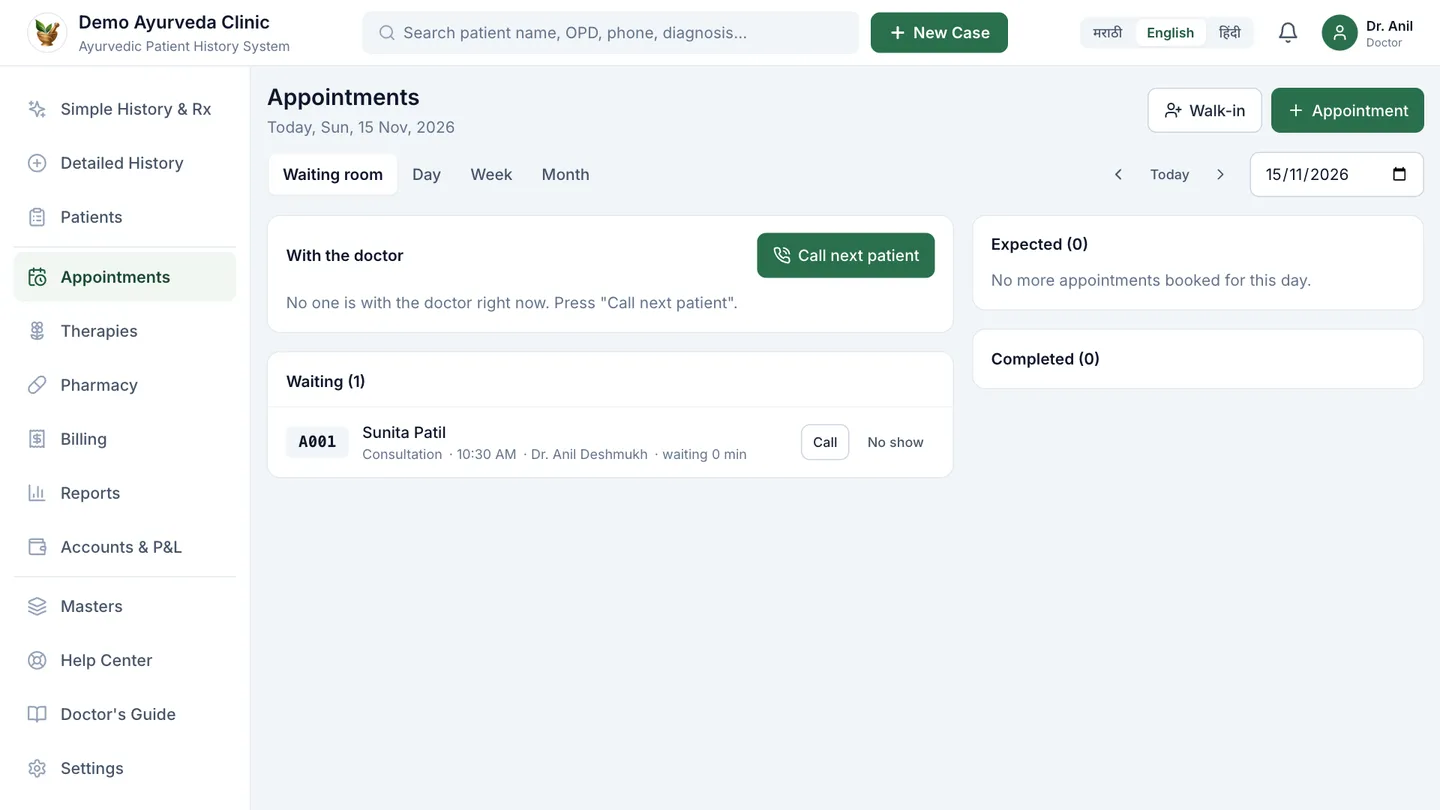
When the doctor saves the case paper, the visit is recorded with its date, doctor, complaint, diagnosis and prescription. The bill and the follow-up date come from the same visit. Searching by name, OPD number or mobile number finds every past visit. Reports show appointments seen, no-shows and collections for any period.
For how a full OPD day runs, see OPD services in an Ayurveda hospital. For hospitals and colleges, see software for AYUSH hospitals and Ayurveda colleges.
Frequently asked questions
What is a daily OPD register?
A day-by-day list of every out-patient seen. It records the date, OPD number, patient details, complaint, diagnosis, treatment and follow-up date. It is the index to the clinic's case papers.
What columns should an OPD register have?
At least Sr. No., OPD No., new or old, patient name, age and sex, mobile number, complaint, diagnosis, treatment and follow-up date. Add time and fee or receipt number if you need them.
How is daily OPD counted?
Count every patient visit in the day, then split it into new and old patients, and into male, female and children. The totals line at the bottom of our free register does this for you.
Is the OPD register different from the case paper?
Yes. The register is a one-line entry per visit. The case paper holds the full history, examination and prescription. The OPD number links the two.
Can software keep the daily OPD register?
Yes. In OPD software every registered visit is an entry, with its date, OPD number, doctor and diagnosis, so the register and the daily count are kept for you.