
Patient Data Security for Ayurvedic Clinics (DPDP Act)
19 November 2026 · AyurHealthPlus
How an Ayurvedic clinic should protect patient records, what the DPDP Act 2023 means for clinics, and what to ask a software vendor about security.
Short answer: Patient records are personal data under India's Digital Personal Data Protection (DPDP) Act, 2023, and the clinic is responsible for protecting them. In practice that means collecting only what you need and telling patients why. Give each staff member their own login with access limited to their role, keep records encrypted and backed up, and know what to do if data leaks. If you use clinic software, the vendor processes data for you. Choose one that encrypts records, keeps each clinic's data separate and gives you role-based logins.
This guide is for Ayurvedic doctors and clinic owners who want to keep patient data safe, on paper and in software. It is practical guidance, not legal advice.
Key points
- Health details are personal data under the DPDP Act. The clinic decides why they are collected, so it carries the duty to protect them.
- Most leaks in small clinics come from shared logins, phones and WhatsApp, not from hackers.
- Every staff member should have their own login, and see only what their role needs.
- Ask your software vendor how data is encrypted, separated and backed up, and who can read it.
What the DPDP Act means for a clinic
The Digital Personal Data Protection Act, 2023 applies to digital personal data, including data collected on paper and later entered into a computer. For a clinic, the main duties are:
- Notice and consent: tell patients what data you collect and why, and use it only for that purpose
- Reasonable security safeguards: protect the data you hold, including data held by your software vendor on your behalf
- Breach notice: if data is leaked, inform the Data Protection Board and the affected patients
- Erasure: delete data that is no longer needed, subject to laws that require you to keep medical records
- A contact for complaints: patients should know whom to ask about their data
The DPDP Rules were notified in November 2025, and most duties apply after a phase-in period. Check the current dates and your obligations with your adviser. Failing to take reasonable security safeguards can attract heavy penalties under the Act.
Where clinic data actually leaks
- Shared logins: one password for the whole clinic, so nobody knows who opened what
- Phones: case papers and lab reports photographed and sent on personal WhatsApp
- Paper: case sheets left on the reception desk, or old files thrown away whole
- Spreadsheets: patient lists emailed or copied to pen drives
- Former staff: logins that still work after someone leaves
Practical steps for an Ayurvedic clinic
- Collect only what you need. Name, age, contact, history and examination, but not, for example, Aadhaar numbers you don't use.
- Give each person their own login. Remove it on their last day.
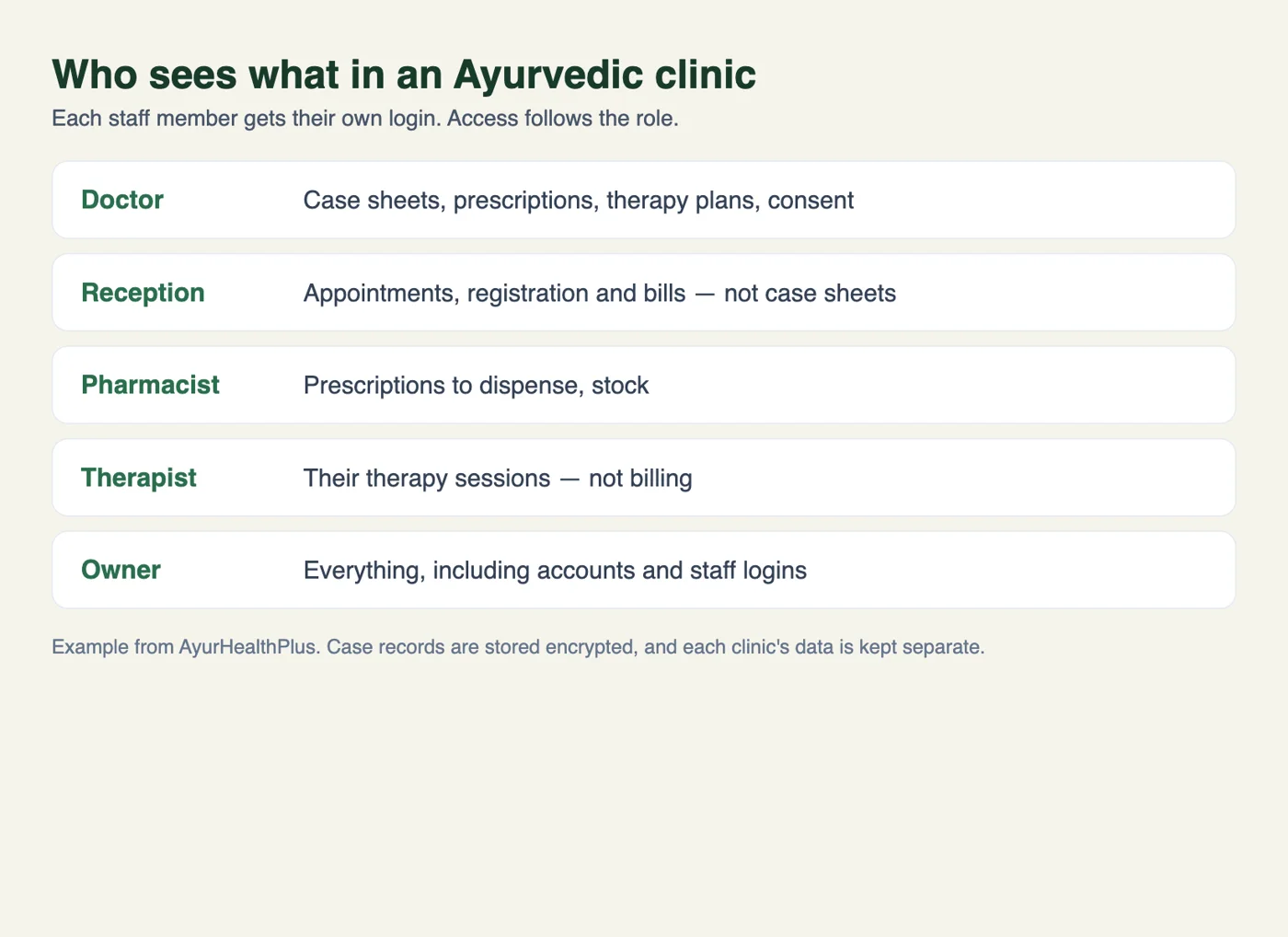
- Limit access by role. Reception doesn't need the case sheet, and a therapist doesn't need the bills.
- Keep records encrypted and backed up, and don't keep copies on personal phones.
- Use a strong password or a one-time code to sign in, and never share it.
- Store paper securely and shred it when you discard it.
- Tell patients how you use their data. A short notice at reception is a good start.
- Know what to do after a leak: who decides, whom to inform and how to stop it happening again.
What to ask a clinic software vendor
- Are case records encrypted when stored?
- Is each clinic's data kept separate from other clinics?
- Can each staff member have their own login, limited by role?
- How do doctors sign in: password only, or a one-time code too?
- Where is the data hosted, and how is it backed up?
- What happens to your data if you stop using the software?
- Who at the vendor can read patient records, and when?
A vendor who can't answer these clearly is a risk, however good the features look.
How AyurHealthPlus protects patient data
- Encrypted records: case records are stored encrypted (AES-256).
- Separate clinics: each clinic's data is kept separate from every other clinic.
- Role-based logins: doctors, receptionists, pharmacists, therapists and nurses each get their own login, and see only what their role needs. Accounts are visible to the owner only.
- Sign-in: password, Google sign-in or a one-time code sent to the doctor's email.
- Consent records: signed consent forms are kept in the patient's file with the version of the form. See our Panchakarma consent form guide.
See Ayurveda EMR software for how the patient record is organised, or Ayurvedic clinic management software for the full feature list.
Frequently asked questions
Does the DPDP Act apply to small clinics?
Yes. The DPDP Act applies to anyone who processes digital personal data, whatever their size, and patient records are personal data. Check with your adviser how the current rules apply to your clinic.
Is patient data safe in cloud clinic software?
It can be safer than paper or spreadsheets if the software encrypts records, keeps each clinic's data separate and limits access by role. Ask the vendor about each of these before you buy.
Who is responsible for patient data, the clinic or the software company?
The clinic decides why data is collected, so it is responsible under the DPDP Act. The software company processes the data on the clinic's behalf, and must keep it secure as agreed with the clinic.
Should clinic staff share one login?
No. Shared logins hide who opened which record, and keep working after staff leave. Give each person their own login, limited to their role.
Can a receptionist see case sheets in AyurHealthPlus?
No. The reception role books appointments, registers patients and makes bills without opening clinical case sheets.