
Ayurvedic HMS: How to Choose Hospital Management Software
17 November 2026 · AyurHealthPlus
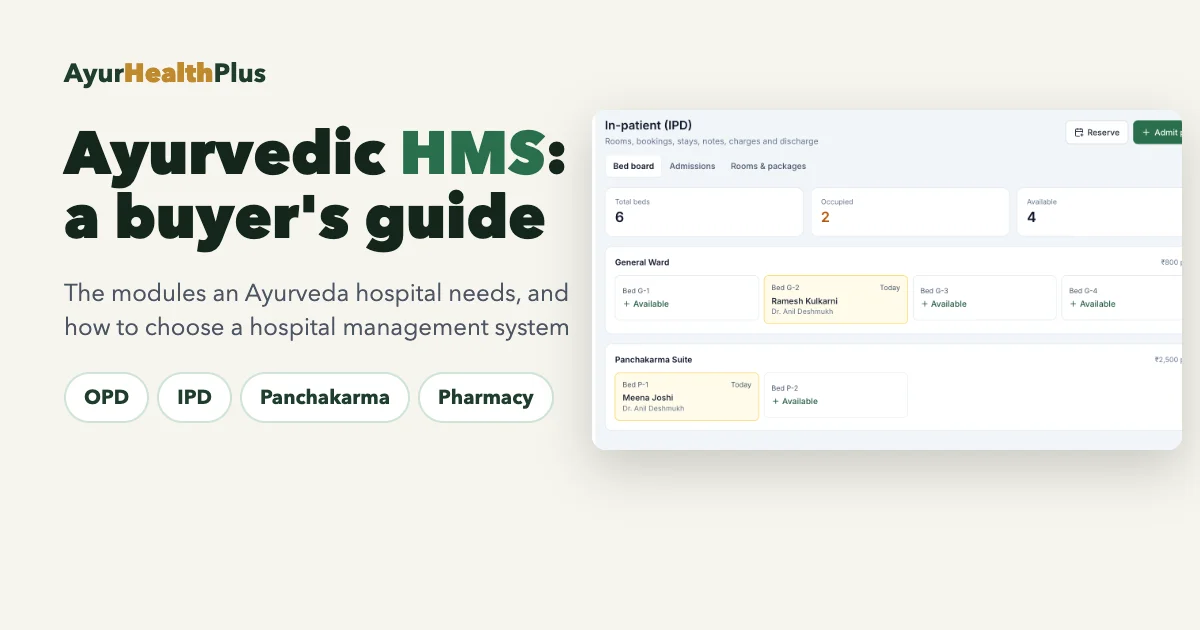
What an Ayurvedic HMS should include for OPD, IPD, Panchakarma, pharmacy, billing and staff, plus a checklist for choosing one for an Ayurveda hospital.
Short answer: An Ayurvedic HMS (hospital management system) is software that runs an Ayurveda hospital's daily work in one place. That covers the OPD and case history, the in-patient wards and beds, Panchakarma, the pharmacy, billing and staff logins. What separates it from a general hospital system is the Ayurvedic side: case sheets with Prakriti and Ashtavidha Pariksha, prescriptions with Anupana and Pathya–Apathya, and Panchakarma courses booked by room and therapist. Choose one by checking these Ayurveda-specific modules first, then billing, data security and price.
This guide explains which modules an Ayurveda hospital needs, what to check in each, and how to compare an Ayurvedic HMS with a general hospital ERP. It is written for owners, medical directors and administrators of Ayurvedic hospitals, Panchakarma hospitals and AYUSH hospitals.
Key points
- An Ayurveda hospital needs seven modules: OPD, IPD, Panchakarma, pharmacy, billing, staff and reports, all sharing one patient record.
- General hospital software usually has no fields for the Ayurvedic assessment, prescription or Panchakarma. Check this first.
- IPD should cover beds, admissions, notes, deposits, discharge summary and one final bill per stay.
- Ask where patient data is stored, whether it is encrypted, and who can see what.
- Ask whether the price is per hospital or per user, and test with a trial before you commit.
What is an Ayurvedic HMS?
An Ayurvedic HMS is hospital management software built around Ayurvedic practice. A patient registered at the OPD keeps one record for life. Every consultation, admission, Panchakarma session, medicine dispensed and bill is added to that record. Doctors, nurses, therapists, pharmacists and the front desk each work in their own part of the system, with access limited to what their role needs.
The word "ERP" is often used for the same thing. In practice, an Ayurvedic hospital needs the clinical and billing modules every day, while large ERP extras (payroll, procurement workflows, HR) matter less.
Which modules does an Ayurveda hospital need?
1. OPD
Patient registration with an OPD number, an appointment and token queue for each doctor, and a structured Ayurvedic case sheet. The sheet should cover Prakriti, Agni, Koshtha, Ashtavidha and Dashavidha Pariksha, Samprapti and Chikitsa. The prescription should handle dose, timing, Anupana and Pathya–Apathya. See our guides on the OPD services and daily OPD register.
2. In-patient (IPD)
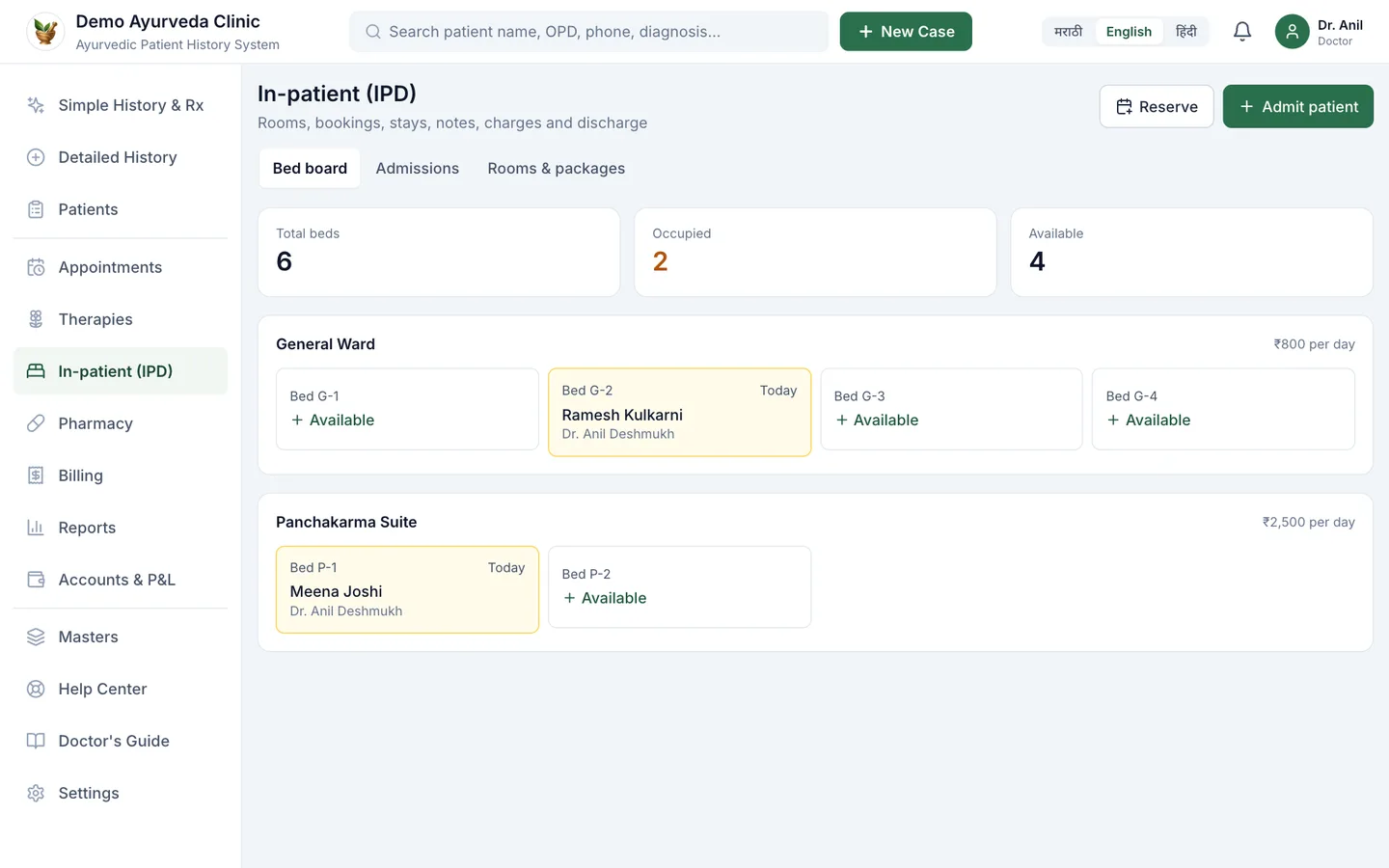
A bed board showing every ward and bed and who is in it, and admissions from the bed board or straight after the consultation. It should also handle bed transfers, nursing, doctor and diet notes, deposits during the stay, a discharge summary, and one final bill for the whole stay.
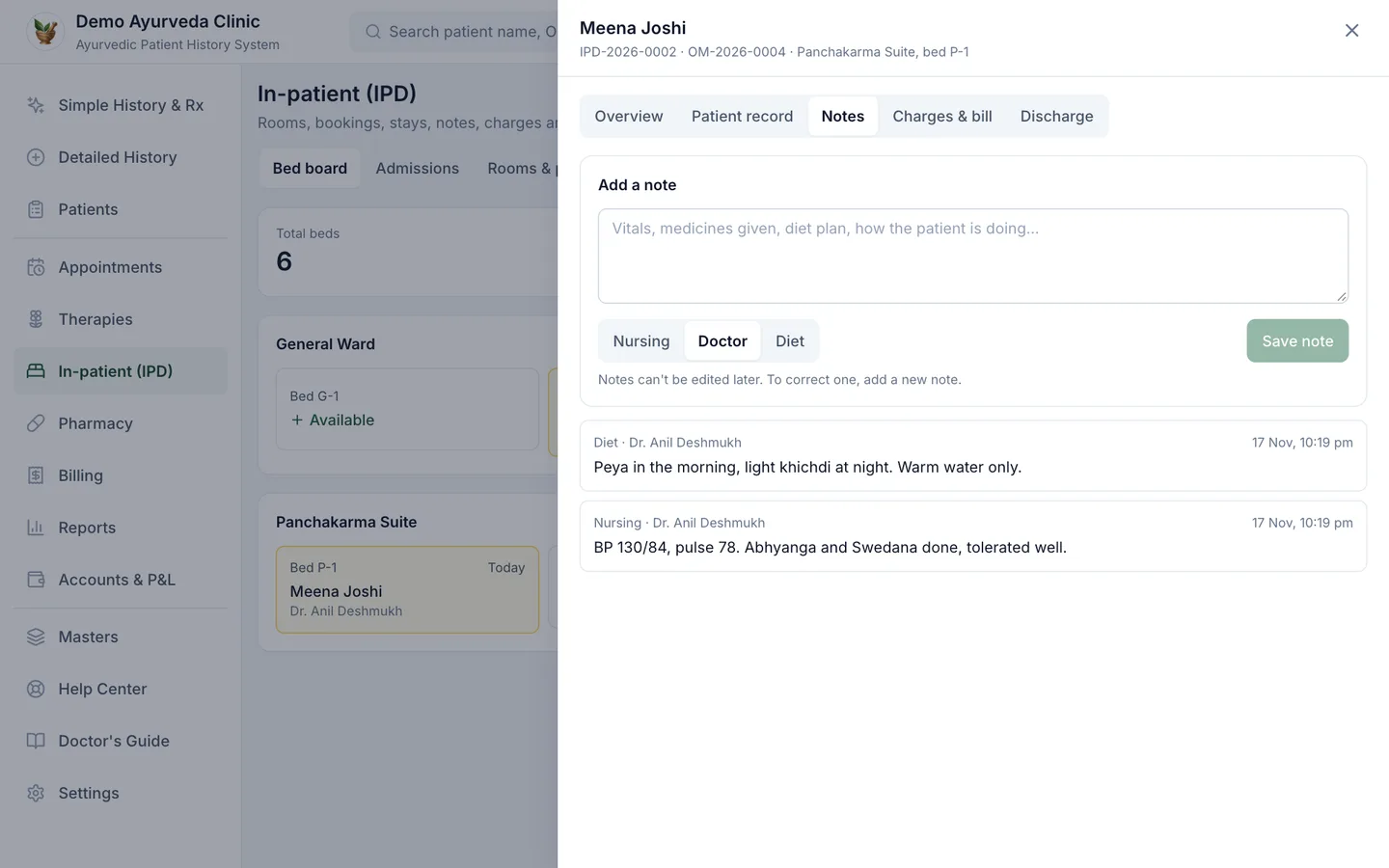
Notes should be dated, signed by the person who wrote them, and impossible to edit afterwards. A correction is a new note. That protects both the patient and the hospital.
3. Panchakarma
Therapy plans in the patient's record, sessions booked by date, room and therapist with no double-booking, session notes, consent forms, and package or per-session billing. Our Panchakarma centre guide covers this in detail.
4. Pharmacy
Stock by batch and expiry, dispensing straight from the doctor's prescription, low-stock and near-expiry alerts, and dispensed medicines added to the patient's bill. See pharmacy stock management.
5. Billing
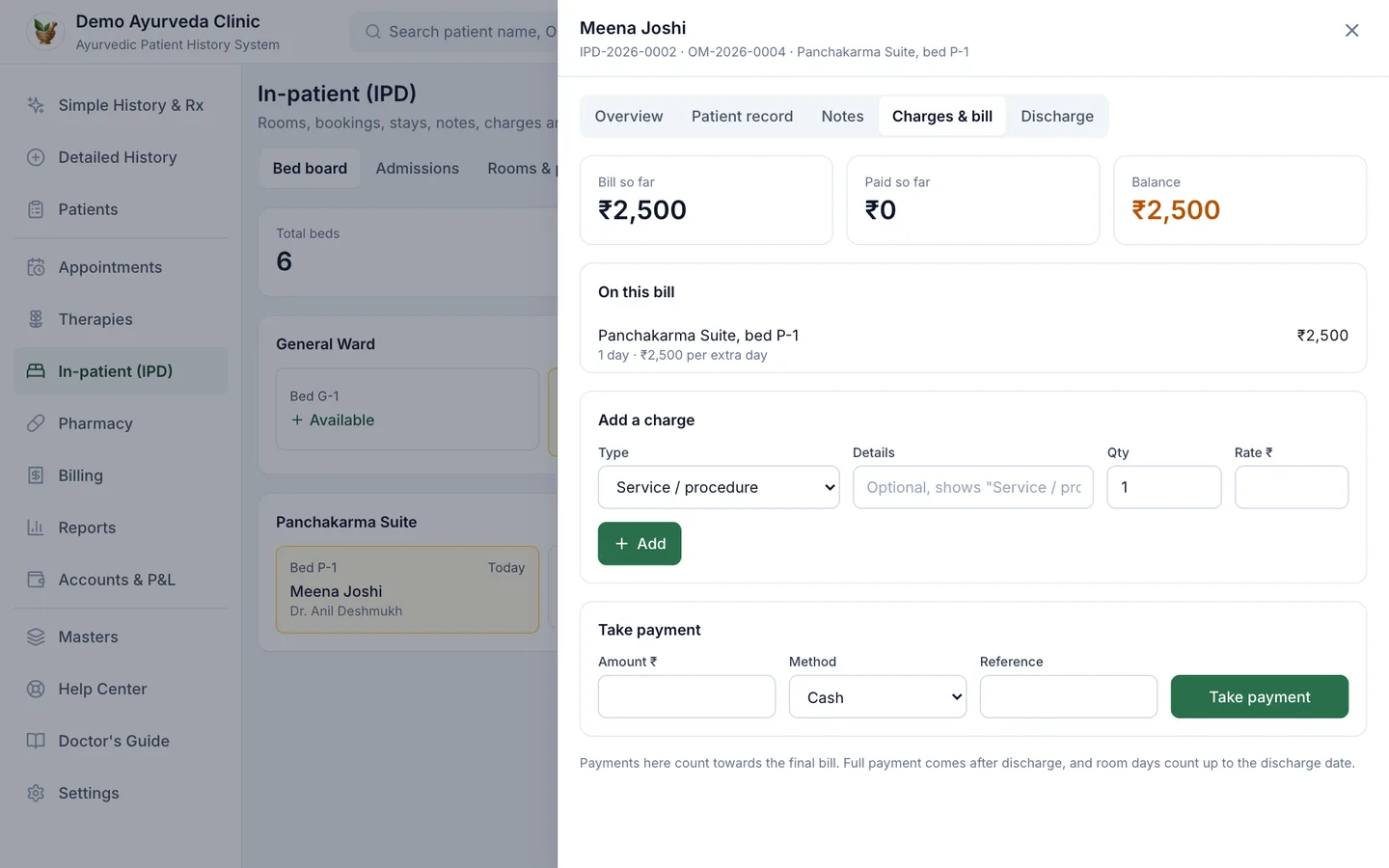
OPD bills, in-patient running bills and final bills, with consultation, room days, therapy, medicines and procedures together. It should also handle discounts, part payments, deposits and refunds, and GST invoices if the hospital is registered.
6. Staff and access
Separate logins for doctors, nurses, receptionists, pharmacists and therapists. Each role sees only what it needs. A therapist sees sessions, not the accounts.
7. Reports and accounts
Daily collection, outstanding dues, appointments and waiting time, therapy sessions, stock value, and for the owner, expenses and profit and loss.
Ayurvedic HMS or general hospital ERP?
A general hospital ERP is built for allopathic hospitals: modern diagnoses, drug formularies, lab and radiology integration. It can run an Ayurveda hospital's admissions and billing, but the doctors end up writing the Ayurvedic assessment, Anupana and Panchakarma plans in free-text boxes, or on paper.
An Ayurvedic HMS starts from the Ayurvedic case sheet and Panchakarma. It may not include a laboratory information system, so check how lab results are recorded or attached.
Choose a general ERP if the hospital is mainly allopathic with a small Ayurveda wing. Choose an Ayurvedic HMS if Ayurveda is the main practice. For an AYUSH hospital with several systems, check which ones each product actually supports. See software for AYUSH hospitals and Ayurveda colleges.
Checklist: questions to ask before you buy
- Does the case sheet have Ayurvedic fields, or only modern history and diagnosis?
- Can a prescription carry Anupana and Pathya–Apathya, and be printed or shared on WhatsApp?
- Are Panchakarma sessions booked by room and therapist, and are clashes blocked?
- Does the IPD module give one final bill for the stay, with room days, therapy and medicines included automatically?
- Is pharmacy stock tracked by batch and expiry, and dispensed from the prescription?
- Can each staff member have their own login with limited access?
- Where is patient data stored, is it encrypted, and is each hospital's data kept separate?
- Does it work in the languages your staff and patients use?
- Is it priced per hospital or per user, and what does a trial include?
- Can the IPD part be switched off if you run only an OPD today?
How AyurHealthPlus fits
AyurHealthPlus is an Ayurvedic HMS for Ayurvedic clinics and hospitals. It covers OPD, in-patient wards, Panchakarma, pharmacy, billing, staff logins and the owner's accounts, with AI voice case history in Marathi, Hindi and English. In-patient care is a setting: an OPD-only clinic keeps it off, and every visit is billed as a normal OPD bill. It does not include a laboratory system. See Ayurveda hospital management software for the full module list, or prices and plans.
Frequently asked questions
What is an Ayurvedic HMS?
Hospital management software built for Ayurvedic hospitals. It runs the OPD, in-patient wards, Panchakarma, pharmacy, billing and staff logins around one patient record, with Ayurvedic case sheets and prescriptions.
What modules should Ayurveda hospital software have?
OPD with an Ayurvedic case sheet, IPD with beds and discharge, Panchakarma scheduling, pharmacy with batch and expiry, billing with deposits and final bills, staff logins and reports.
Is an Ayurvedic HMS the same as an Ayurvedic ERP?
Mostly. Both terms describe software that runs the hospital. An ERP often adds HR, payroll and procurement. An Ayurveda hospital uses the clinical and billing modules every day, so check those first.
Can a small Ayurvedic clinic use hospital software?
Yes, if the in-patient part can be switched off. In AyurHealthPlus, in-patient care is a setting, so a clinic can start with OPD and turn on IPD when it adds beds.
Does an Ayurvedic HMS include a laboratory module?
Not always. AyurHealthPlus does not include a laboratory system. Lab results can be recorded or attached to the patient record.